Free Pattern
Step-by-Step
Crochet
Granny SquaresGerbera Daisy Flower Granny Square Crochet Pattern
Crochet a bright gerbera daisy granny square with bobble-stitch petals in three colors — an intermediate 6-round pattern finishing at 4.5 inches square
Level IntermediateTime 1-2 HoursYarn DK
About This Pattern
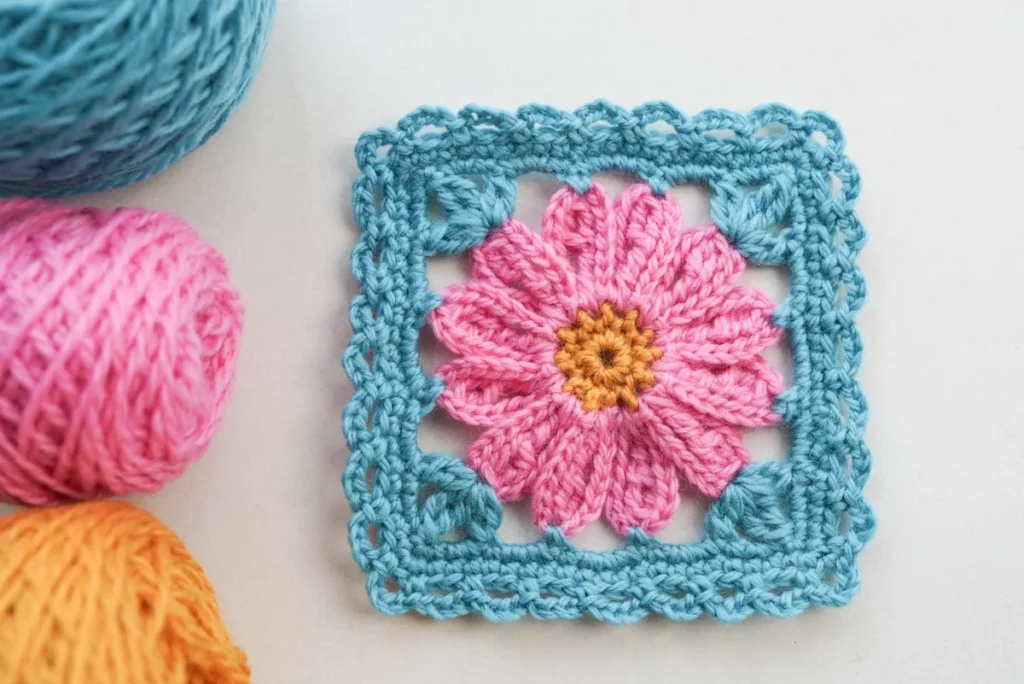
This pattern creates a cheerful gerbera daisy worked as a flat granny square — a single motif where bold bobble-stitch petals radiate out from a sunny center against a solid background. What makes it special is the way those raised petals pop off the surface, giving a two-tone flower that looks almost real. It's perfect for anyone who loves floral motifs and wants a single, satisfying square they can turn into a coaster, a bag panel, or one bright tile in a much bigger blanket project
You'll work through six rounds using treble crochet, clustered bobble stitches, and plain double crochet, plus a couple of color changes to move from the center to the petals to the background. I'd call this a confident-beginner to intermediate make: if you can already work a basic granny square and don't mind managing a few yarn ends, you're ready for it. Each square takes most crocheters roughly one to two hours, so it's an easy afternoon project you can happily finish in a single sitting
The finished square measures approximately 4.5 by 4.5 inches in DK or sport-weight yarn, with a firm, slightly textured feel thanks to those raised bobble petals. In the classic red, yellow, and cream palette it reads instantly as a gerbera, but it looks just as lovely in soft pastels. It makes a sweet standalone gift — think a little coaster tucked into a card — or gather a dozen for a floral blanket that any flower lover would absolutely treasure
Variations
The three-color format practically begs you to play. For a soft, romantic gerbera, try dusty pink petals with a pale yellow center against a mint green background; for something bold and modern, go vibrant purple petals, a deep orange center, and a contrasting teal border. Since real gerberas come in almost every shade, you honestly can't pick a wrong combo. Want an autumn version? Rust and pumpkin petals with a cream center look gorgeous piled into a fall blanket. For a wintry twist, work icy blue petals with a white center and a charcoal background. To resize the square, swap yarn weights rather than fighting the stitch counts: the same six rounds in worsted with a 5mm hook grow the square to roughly 5.5 inches, while a fine 4-ply and a 3mm hook shrink it toward 3.5 inches — handy if you're matching an existing blanket. If you need it bigger without changing yarn, add a seventh round of plain double crochet around the border, working three double crochet into each corner space to keep the square flat. For yarn, a smooth cotton like Paintbox Cotton DK or Scheepjes Catona makes the bobble petals crisp and defined, while a soft acrylic such as Stylecraft Special DK gives a cozier, more huggable finish for blankets. You can also go tonal — three shades of the same color — for an elegant, textural take where the petals show up through dimension rather than contrast. Metallic or sparkle yarn turns the same motif into sweet little ornaments and gift toppers
Common mistakes
- Floppy, flat-looking bobble petals that
- You're likely pulling each loop up too long before closing. Draw every loop up only to about the height of a treble, keep an even tension, and the finished bobble will pop forward proudly instead of collapsing
- Losing count of the loops on the hook
- Each treble in the cluster leaves two loops behind before you close. Pause and count the loops on your hook before the final 'yarn over and pull through all loops' step — closing with the wrong number gives you lumpy, uneven petals
- Corners that pull in and stop the square from lying flat
- The corner spaces need enough stitches to turn the angle — if your square is cupping, you're likely short a stitch or a chain in the corners. Work the full corner grouping (typically three stitches, chain, three stitches) into each corner space to keep it square
- Uneven petal spacing, with the daisy looking lopsided
- This usually traces back to miscounting the plain trebles or double crochets between bobbles. Mark the first stitch of each round and count your stitches at the end of every round before joining, so each petal sits an equal distance from the next
- Woven-in ends peeking through the raised petal texture
- Don't run a contrasting-color tail directly behind the open bobbles — it shows through the gaps. Weave each end along same-color stitches on the back for a few centimeters, then trim, so nothing pokes through the front
Intermediate
Materials
- Yarn of your choice- 3 colors, the sample is made with DK sports
- Crochet hook
- Darning Needle
- Scissors
How to Crochet Gerbera Daisy Granny Square
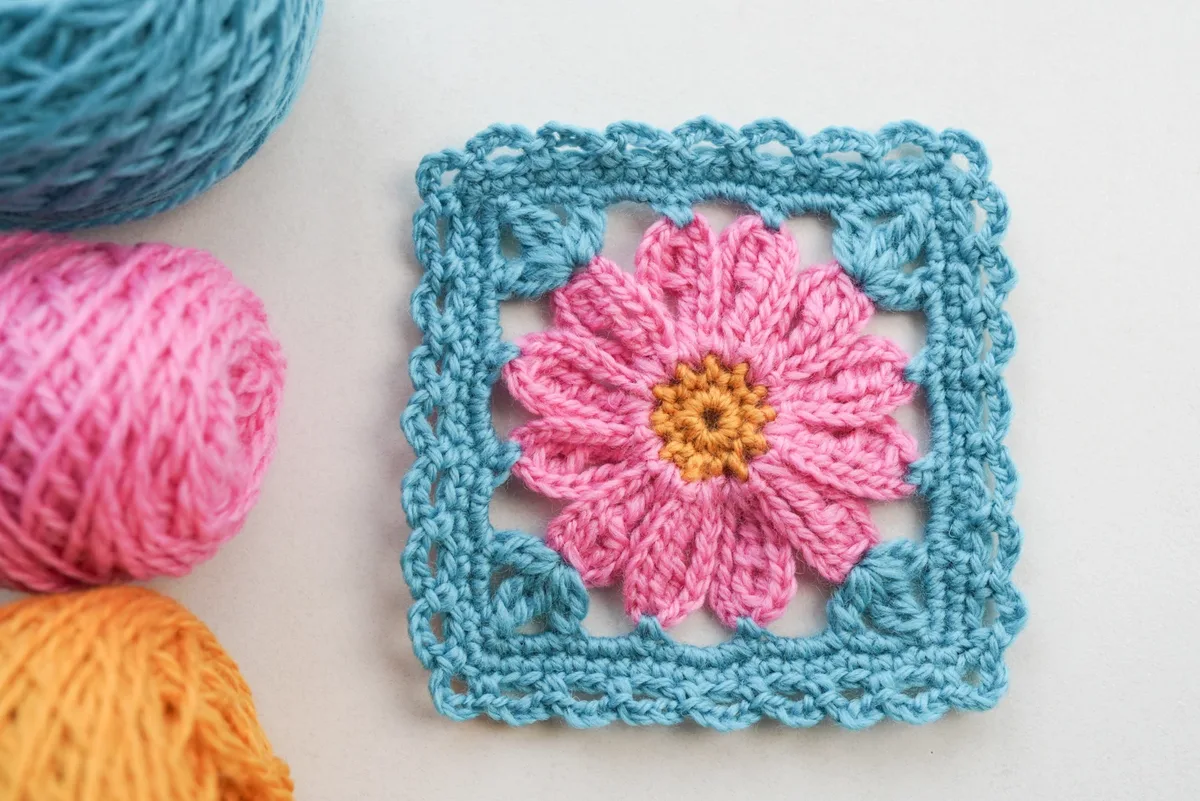
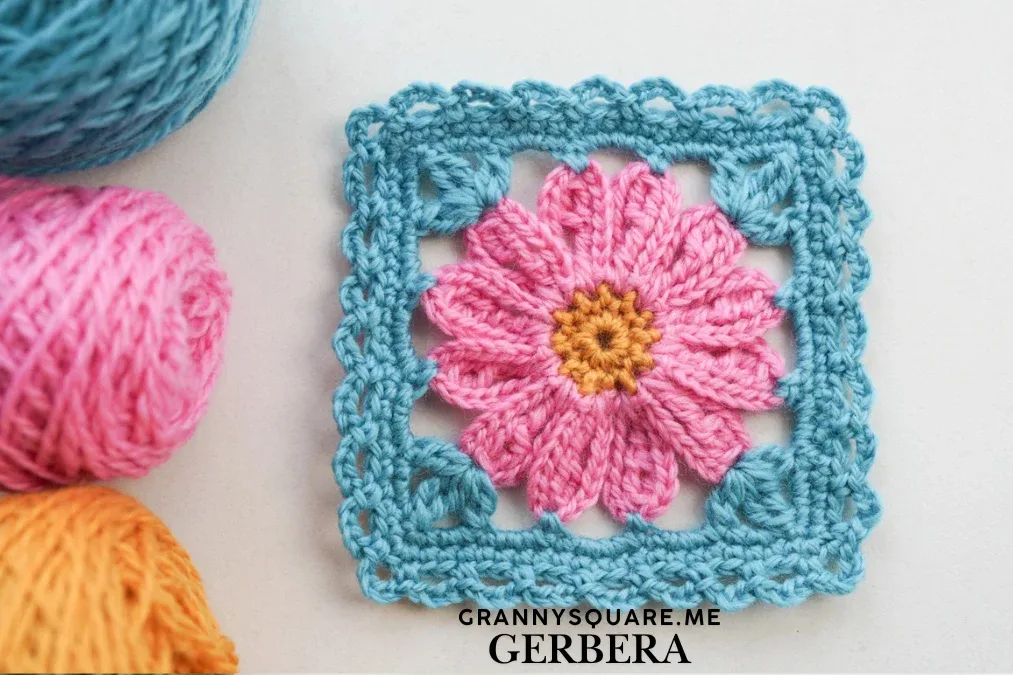
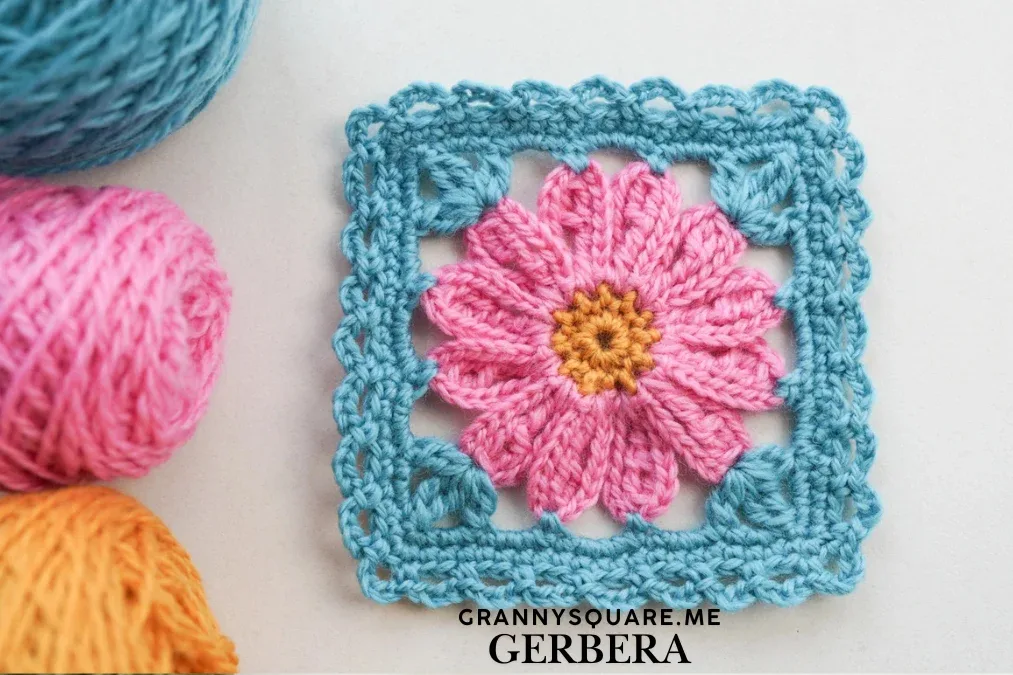
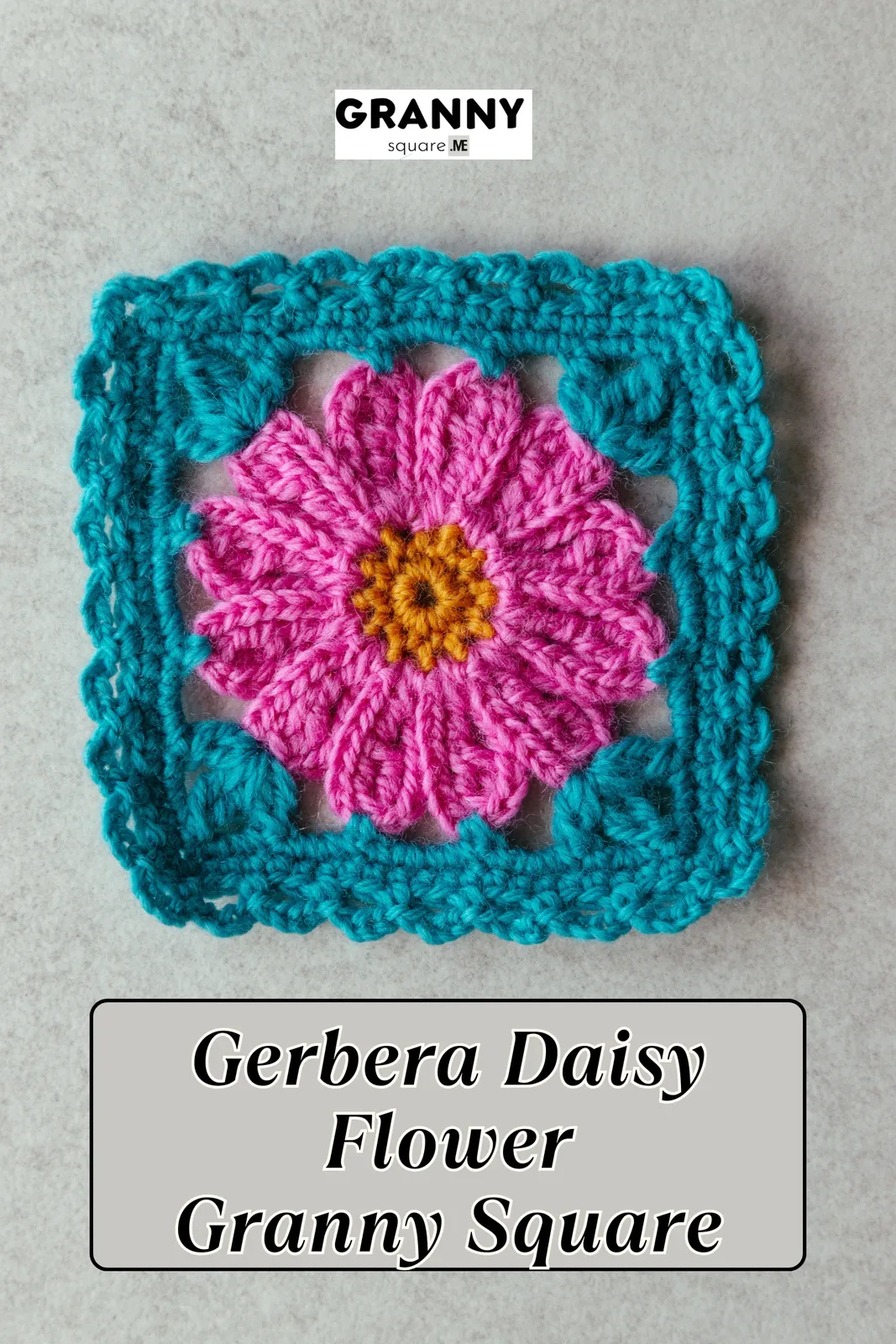
A whimsical daisy bloom with delicately layered petals sits perfectly framed by an airy, vintage-inspired lace border, creating a charming window to springtime.
- Round 1magic ring, ch, 13sc, slst into first ch (13).Step by step: Start with a magic ring; make chain stitch as standing stitch; sc; 12sc; tighten the tail to form a circle; slst into first ch. Round 1 finished.(13)
- Round 2[ch3, slst into next st] rep 12 times, fasten off.Step by step: Make 3 chain stitches; slst into next stitch; [ch3, slst into next stitch] repeat 11 times, fasten off.
Now we finished the center of the daisy flower.
- Round 3Add pink yarn, pull the yarn through any ch-sp, ch7 tr in same ch-sp, 2-tr-bo in the third st of tr, ch7 in same ch-sp, slst into the same ch-sp. [ch7 tr in next ch-sp, 2-tr-bo in the third st of tr, ch7 in same ch-sp, slst into the same ch-sp] repeat 11 times, fasten off.
How to make a 2-tr-bo stitch: 1. yo twice, insert hook into the designated st. 2. yo and pull up a loop (4 loops on your hook). 3. yo and pull through 2 loops (3 loops remain on hook). 4. yo and pull through 2 more loops (2 loops remain on hook) — don't complete this first treble yet. 5. yo twice again, insert hook into the same stitch. 6. Yarn over and pull up a loop (5 loops on hook). 7. Yarn over and pull through 2 loops (4 loops remain). 8. Yarn over and pull through 2 more loops (3 loops remain). 9. Yarn over and pull through all 3 loops on your hook to close the bobble.
Step by step: Add pink yarn, pull the yarn through any ch-sp; make 7 chain stitches; continue make tr in the same ch-sp, don't complete this first treble yet, now you have 2 loops on the hook; yarn over twice, insert hook into the third stitch, now you have 4 loops on the hook; pull through 2 loops, now you have 3 loops on your hook; pull through all 3 loops on your hook to close the bobble, this is the first 2 treble bobble stitch; make ch7; slst into the same ch-sp; [make ch7 tr in next ch-sp, make a 2-tr-bo in the third st of tr, ch7 in same ch-sp, slst into the same ch-sp] repeat 11 times, fasten off. Now you have finished 12 petals of the flower.
- Round 4add blue yarn, ch, sc in the same st, ch4, sc in the next st of 2-tr-bo, ch3, 2-dc-bo ch2 2-tr-bo ch2 2-dc-bo in next st of 2-tr-bo, ch3, [sc in the next st of 2-tr-bo, ch4, sc in the next st of 2-tr-bo, ch3, 2-dc-bo ch2 2-tr-bo ch2 2-dc-bo in next st of 2-tr-bo, ch3] rep 3 times, slst into the first ch.
How to make a 2-dc-bo stitch: 1. yo once (this begins your double crochet), insert hook into the designated stitch. 2. yo and pull up a loop (3 loops on your hook). 3. yo and pull through 2 loops (2 loops remain on hook) — don't complete this first double crochet yet. 4. yo once again, insert hook into the same stitch. 5. yo and pull up a loop (4 loops on hook). 6. yo and pull through 2 loops (3 loops remain). 7. yo and pull through all 3 loops on your hook to close the bobble.
Step by step: Add blue yarn, pull the yarn through stitch of the 2-tr-bo; make chain stitch as standing stitch; sc in the same stitch, ch4, sc in the next stitch of 2-tr-bo, ch3, 2-dc-bo ch2 2-tr-bo ch2 2-dc-bo in next stitch of 2-tr-bo, ch3; [sc in the next stitch of 2-tr-bo, ch4, sc in the next stitch of 2-tr-bo, ch3, 2-dc-bo ch2 2-tr-bo ch2 2-dc-bo in next stitch of 2-tr-bo, ch3] repeat 3 times, slst into the first ch.
- Round 5ch, sc in each of st or ch-sp, slst into the first ch, fasten off.Step by step: Now we turn it into a square. Start with chain stitch; make single crochet in each of ch-sp or stitch, slst into the first ch, fasten off.
- Round 6Add the blue yarn, pull the yarn through the first st besides st of corner sp, ch, sc in same st, [ch4, sk 2 sts, sc] rep 7 times, ch4, sk one st, sc, [*(ch4 sk 2 sts sc) rep* 7 times, ch4, sk st, sc] rep 3 times, slst into the first ch, fasten off.Step by step: Add the blue yarn, pull the yarn through the first st besides st of corner space; make chain stitch as standing stitch; sc in same stitch, [ch4, skip 2 stitches, sc] repeat 7 times, ch4, skip one stitch, sc; [*(ch4 skip 2 stitches sc) repeat* 7 times, ch4, skip one stitch, sc] repeat 3 times, slst into the first ch, fasten off. Now you have finished a gerbera daisy granny square.
Important notes
💡 Use a smooth, light-colored yarn for your first gerbera — DK cotton shows off the bobble petals far better than a fuzzy or dark yarn, so you can clearly see each stitch as you close it
💡 Keep your bobbles firm: pull each loop up only to the height of a treble, never longer, so the finished petal stands proud of the square instead of flopping to one side
💡 Place a stitch marker in the first stitch of each round — with three colors in play it's easy to lose your starting point, and the marker keeps your petal count even all the way around
💡 Change colors on the final yarn-over of the previous round's last stitch so the new shade starts cleanly, rather than cutting and rejoining awkwardly in the middle of a round
💡 A darning needle with a large eye makes tidying the color-change tails much easier — thread each end back through same-color stitches so it disappears behind the petals
💡 Aim for the stated gauge — the completed granny square measures approximately 4.5 by 4.5 inches. Block it gently, hovering a warm iron over a damp cloth without pressing the bobbles flat, to coax the corners into a crisp square before you join anything
More photos
FAQ
What yarn weight should I use for the gerbera daisy square?
The sample uses DK or sport-weight yarn in three colors, which produces a square of about 4.5 by 4.5 inches. Stick to a smooth DK for crisp, well-defined bobble petals, and choose a hook that gives you a firm, even fabric
Is this pattern suitable for beginners?
It sits at a confident-beginner to intermediate level. You'll need to be comfortable with treble crochet, bobble stitches, and a couple of color changes, so it's a great next step once you've already made a plain granny square or two
How many squares do I need for a blanket?
Since each square is roughly 4.5 inches, about five squares across and six down (30 squares) makes a cozy lap blanket around 27 by 27 inches before edging. Scale the grid up or down to hit the size you want, and add a border round for a neat finish
Can I make the square bigger or smaller?
Yes — the easiest way is to change yarn weight, since worsted with a 5mm hook grows it toward 5.5 inches and a fine 4-ply with a 3mm hook shrinks it toward 3.5 inches. To size up without changing yarn, add an extra round of double crochet with three stitches in each corner
How do I join these gerbera squares together?
Any granny-square join works beautifully here. A whip stitch through the back loops keeps the seam flat and invisible, while a continuous join-as-you-go method saves you sewing time if you're making many squares. Match your joining yarn to the background color so the daisies stay the star
Made your own square?
This site belongs to every crocheter. Share your design with the world — we’ll math-check the counts, polish it up, and publish it free for everyone, credited to you.
🧵 Share your pattern →
0 / 0 rounds