Free Pattern
Step-by-Step
Crochet
Granny SquaresLarge Leaf Granny Square – Free Crochet Pattern
Crochet this large leaf granny square with our free pattern — a bold two-color 6-inch motif in DK yarn, perfect for blankets, pillows, and bags
Level IntermediateTime 1-2 HoursHook 3.00 mmYarn DK
About This Pattern
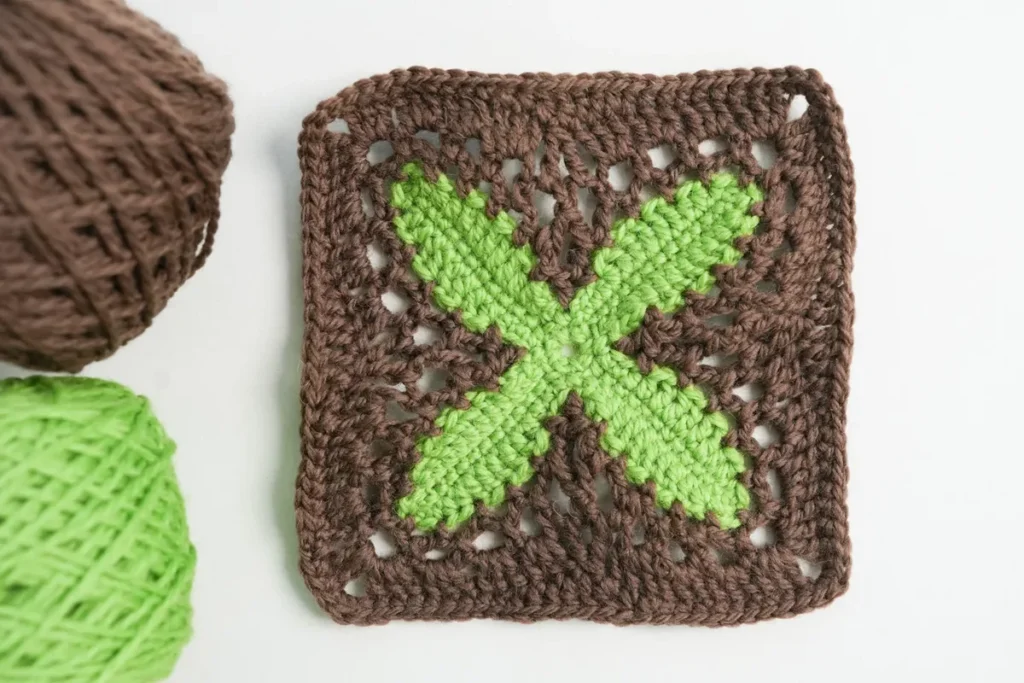
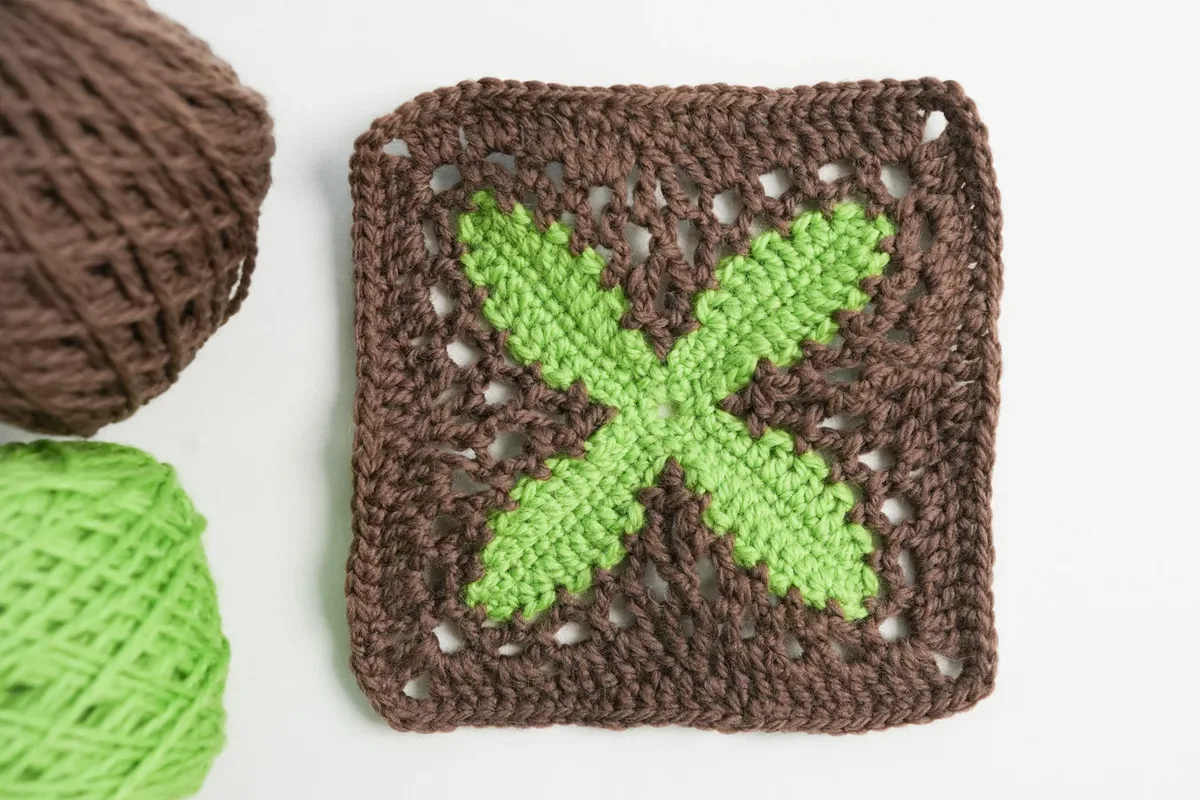
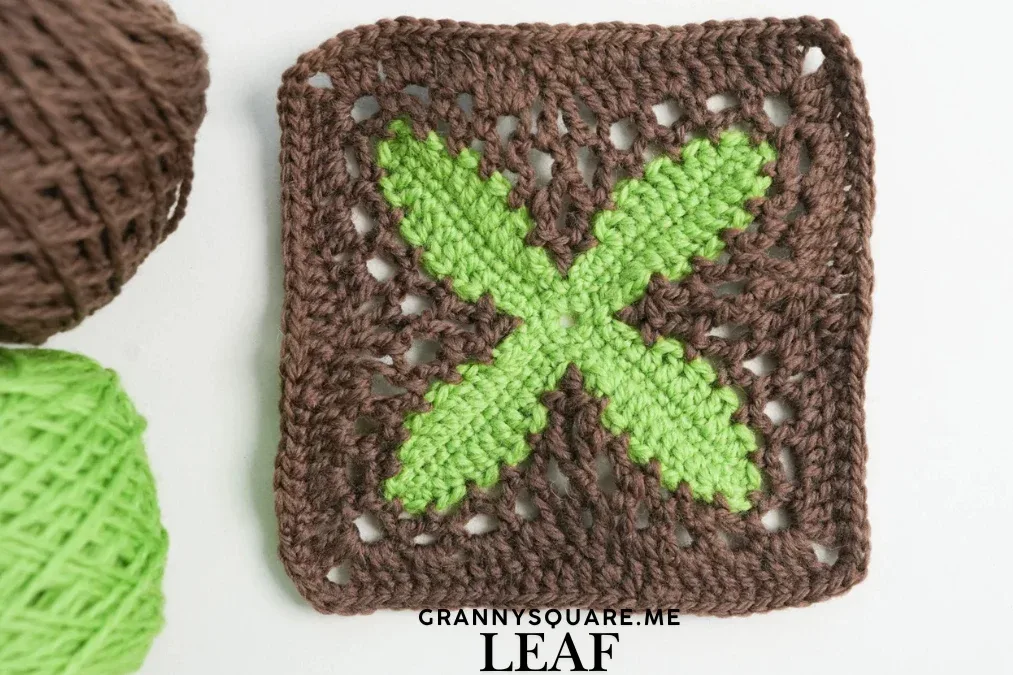
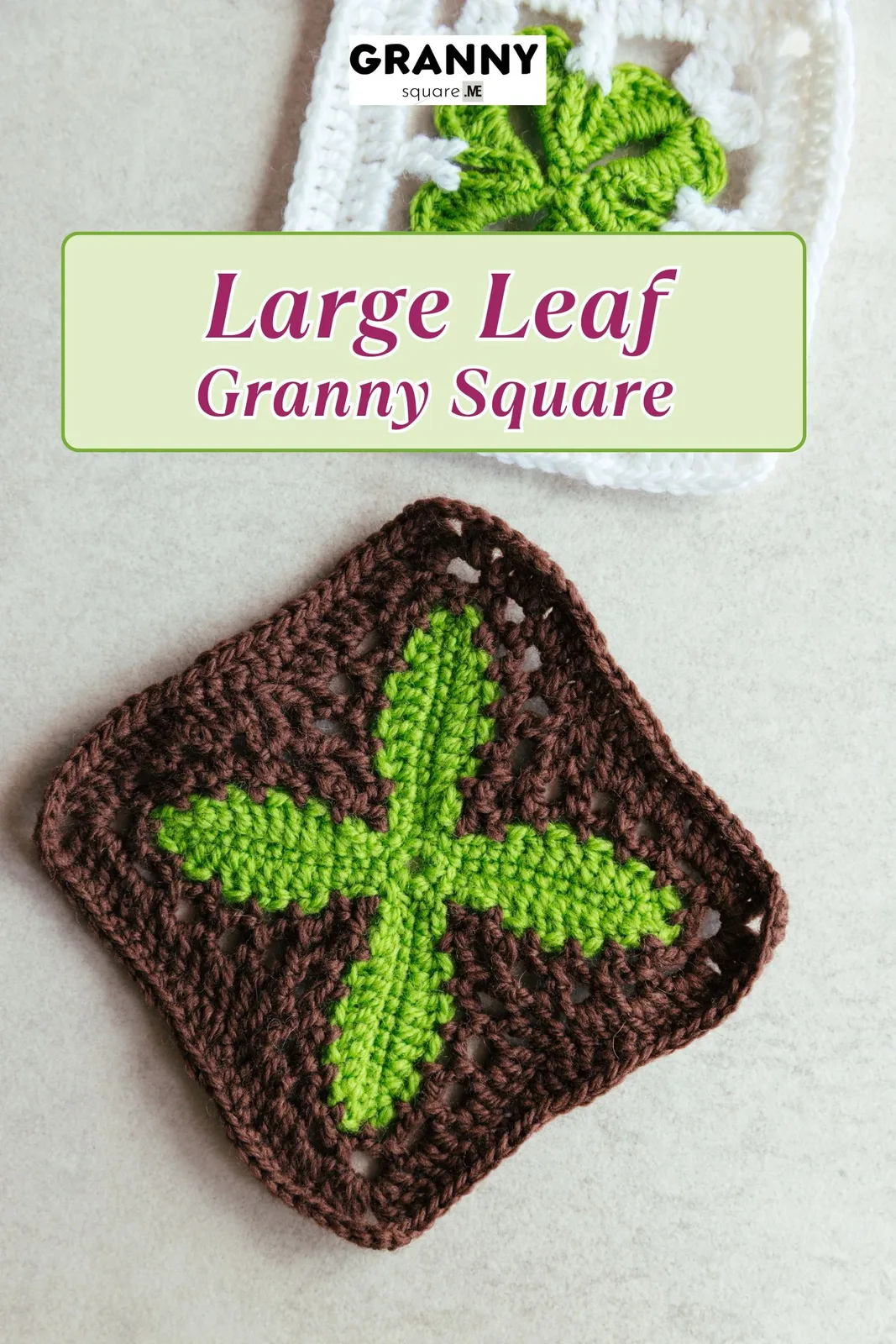
The Large Leaf Granny Square takes the classic granny formula and gives it a gorgeous botanical twist: broad, rounded leaves bloom out from the center ring, framed by clean squaring-off rounds in a contrasting shade. It's a motif square with real personality — the kind that makes people ask 'wait, you actually made that?' If you love nature-inspired crochet, are planning a statement blanket, or simply want a break from the traditional granny cluster grid, this square is going to steal your heart
Worked in DK weight yarn with a 3.00mm hook, each finished square measures a tidy 6 by 6 inches with a firm, crisp fabric that holds the leaf shapes beautifully. The squares join seamlessly into blankets, cushion covers, tote bags, and table runners, and even a single square makes a lovely mug rug or mini wall hanging. Stitch up a stack in seasonal colors and you'll have handmade gifts ready for birthdays, housewarmings, and baby showers all year long
Common mistakes
- Working the center ring and first leaf rounds too tightly
- A snug center makes the leaf rounds cup and pucker instead of lying flat. Keep your starting ring loose enough to comfortably fit all the first-round stitches, and if your motifs consistently dome, go up to a 3.25mm or 3.50mm hook for the center rounds only — you can return to the 3.00mm for the squaring-off rounds
- Changing to the background color with a
- If you finish the final leaf-round stitch entirely in the old color, you'll get a little blip of the wrong shade bleeding into your background rounds. Work the last stitch of the leaf color up to its final yarn over, then pull the new background color through to complete it — the transition will be perfectly clean
- Placing corner clusters in the wrong
- The corners are what transform the round leaf motif into a true 6-inch square, and one misplaced corner group skews the whole shape into a lopsided diamond. Drop a stitch marker into each of the four corner chain spaces as soon as you create them, and move the markers up every round so the (cluster, chain, cluster) corner groups always land exactly where they belong
- Working granny clusters into stitches
- Like a classic granny square, the clusters in the framing rounds go into the gaps between the previous round's clusters, not into the tops of stitches. If your rounds feel tight and your cluster count keeps coming up wrong, double-check that your hook is diving into the chain spaces — the fabric should grow with an open, even rhythm
- Losing count of clusters between the corners
- seven rounds building on each other, one missing cluster in round five throws off every corner in rounds six and seven. Pause at the end of each round and count the clusters along each side — all four sides should match. Catching an error one round late is a two-minute fix; catching it at bind-off means ripping back half the square
- Skipping blocking before joining squares
- Unblocked squares have wavy edges and slightly bowed leaves, and those small inconsistencies multiply across a blanket. Pin each square out to exactly 6 by 6 inches, mist with water, and let it dry completely. Blocked squares seam together evenly and the leaf motifs sit beautifully flat and defined
Intermediate
Materials
- Yarn of your choice- 2 colors, the sample is made with DK sports
- Crochet hook – we are using a 3.00mm hook
- Darning Needle
- Scissors
Main Pattern
- Round 1knot, ch6, slst to first ch, do not fasten off.Step by step: Start with a knot; make 6 chain stitches; slst to first ch to form a circle, do not fasten off. Round 1 finished.
- Round 2ch1 as standing st, sc, ch14, sc in the blo of the 2nd ch from the end, 12sc in the blo of following 12 ch-sps, [sc into the circle, ch14, sc in the blo of the 2nd ch from the end, 12sc in the blo of following 12 ch-sps] rep 3 times, slst to first sc.
Step by step: Make ch1 as standing st; sc; ch14; insert your needle into the back loop only of the second chain from the end and sc in the back loop only of the second chain from the end; 12sc in the back loop only of following 12 chain spaces; [sc into the circle, ch14, sc in the back loop only of the second chain from the end, 12sc in the back loop only of following 12 chain spaces] repeat 3 times; slst to first sc. Round 2 finished.
- Round 3ch1 as standing st, sc in the flo of first ch-sp, 2sc in next 2 ch-sps, 2hdc in next 2 ch-sps, 5dc in next 5 ch-sps, 2hdc in next 2 ch-sps, 2sc in next 2 ch-sps, 2sc, 2hdc, 5dc, 2hdc, 2sc, [sc in the flo of first ch-sp, 2sc in next 2 ch-sps, 2hdc in next 2 ch-sps, 5dc in next 5 ch-sps, 2hdc in next 2 ch-sps, 2sc in next 2 ch-sps, 2sc, 2hdc, 5dc, 2hdc, 2sc] rep 3 times, slst to first sc, fasten off.
Step by step: Make ch1 as standing st; insert your needle into the front loop only of first ch-sp and sc in the front loop only of first ch-sp; 2sc in next 2 ch-sps, 2hdc in next 2 ch-sps, 5dc in next 5 ch-sps, 2hdc in next 2 ch-sps, 2sc in next 2 ch-sps; insert your needle into the first st of sc; 2sc, 2hdc, 5dc, 2hdc, 2sc; [sc in the front loop only of first ch-sp, 2sc in next 2 ch-sps, 2hdc in next 2 ch-sps, 5dc in next 5 ch-sps, 2hdc in next 2 ch-sps, 2sc in next 2 ch-sps, 2sc, 2hdc, 5dc, 2hdc, 2sc] repeat 3 times, slst to first sc, fasten off. Then we finished four leaves. Round 3 finished.
- Round 4Add new yarn,pull through top of second sc, ch1 as standing st, sc, ch3, sk, sc, [ch3, sc, sk ] rep 5 times, sk 2, dc, sk 3, [sc, ch3] rep 4 times, [*(sc, ch3, sk) rep* 6 times, sc, sk 2, dc, sk 3, *(sc, ch3) rep* 4 times] rep 3 times, slst to first sc.Step by step: Add new yarn, pull the yarn through top of second sc st; ch1 as standing st; sc; ch3, skip 1, sc; [ch3, sc, skip 1] repeat 5 times; skip two, dc; skip 3, [sc, ch3] repeat 4 times; [*(sc, ch3, skip 1) repeat* 6 times, sc, skip 2, dc, skip 3, *(sc, ch3) repeat* 4 times] repeat 3 times; slst to first sc. Round 4 finished.
- Round 5ch1 as standing st, sc, ch4, [sc, ch4] rep 4 times, dc2tog, ch4, [sc, ch4] rep 3 times, [*(sc, ch4) rep* 5 times, dc2tog, ch4, *(sc, ch4) rep * 3 times] rep 3 times, slst to first sc.Step by step: ch1 as standing st; sc; ch4; [sc, ch4] repeat 4 times; make double crochet 2 stitches together; ch4; [sc, ch4] repeat 3 times; [*(sc, ch4) repeat* 5 times, dc2tog, ch4, *(sc, ch4) repeat* 3 times] repeat 3 times, slst to first sc. Round 5 finished.
How to make a dc2tog: 1. yo, insert your hook into the first stitch; 2. yo and pull up a loop (3 loops on your hook); 3. yo and pull through 2 loops only (2 loops remaining on your hook); 4. yo again, insert your hook into the next stitch; 5. yo and pull up a loop (4 loops on your hook); 6. yo and pull through 2 loops (3 loops remaining on your hook); 7. yo one final time and pull through all 3 remaining loops on your hook.
- Round 6ch3(count as dc), (2dc+ch3+3dc) in corner sp, *3dc in next ch-sp, rep* 3 times, tr2tog, *3dc in next ch-sp, rep* 3 times, [*(3dc+ch3+3dc) in corner sp, *3dc in next ch-sp, rep* 3 times, tr2tog, *3dc in next ch-sp, rep* 3 times] rep 3 times, slst to top of ch3.Step by step: Now we turn it into a square. Make 3 chain stitches as standing stitch; (2dc+ch3+3dc) in corner space; *3dc in next ch-sp, repeat* 3 times; make treble crochet 2 stitches together; *3dc in next ch-sp, repeat* 3 times; [*(3dc+ch3+3dc) in corner space, *3dc in next ch-sp, repeat* 3 times, tr2tog, *3dc in next ch-sp, repeat* 3 times] repeat 3 times, slst to top of ch3. We finished round 6.
How to make a tr2tog: 1. yo twice, insert your hook into the first stitch; 2. yo and pull up a loop (4 loops on your hook); 3. yo and pull through 2 loops (3 loops remain); 4. yo and pull through 2 more loops (2 loops remain); 5. yo twice again, insert your hook into the next stitch; 6. yo and pull up a loop (5 loops on hook); 7. yo and pull through 2 loops (4 loops remain); 8. yo and pull through 2 more loops (3 loops remain); 9. yo and pull through all 3 remaining loops.
- Round 7ch1 as standing st, 3sc, 3sc in corner sp, 9sc, 2hdc, 3dc, 2hdc, 6sc, [3sc, 3sc in corner sp, 9sc, 2hdc, 3dc, 2hdc, 6dc] rep 3 times, slst to first sc, fasten off.Step by step: ch1 as standing st; 3sc; 3sc in corner space; 9sc; 2hdc, 3dc, 2hdc; 6sc; [3sc, 3sc in corner space, 9sc, 2hdc, 3dc, 2hdc, 6dc] repeat 3 times, slst to first sc, fasten off, weave in ends and cut off extra yarn. Then we finished the large leaf granny square.
Important notes
💡 Gauge: the finished granny square is 6 inches by 6 inches in DK yarn with a 3.00mm hook. Check your size after round four — if your motif is tracking noticeably larger or smaller at the halfway point, adjust your hook by a quarter millimeter now rather than after all seven rounds are done
💡 Contrast is everything with this motif. For different looks, try a white leaf on a navy background for a midnight-garden feel, or a golden yellow leaf on forest green for a reverse contrast. Hold your two yarns side by side in daylight before you start — if you squint and the colors blur together, the leaf will disappear into the background
💡 Place a stitch marker in each of the four corner chain spaces the moment you form them in the squaring-off rounds, and move the markers up as you go. It's the single easiest way to keep the square truly square
💡 Count your clusters at the end of every single round. Seven rounds sounds quick, but each round builds directly on the last, so an early miscount compounds into crooked corners by the final round
💡 A darning needle with a large eye is your friend for this two-color square — you'll have at least four ends to weave. Weave each end diagonally through the backs of stitches for an inch, then back on itself, so the tails stay locked even after machine washing a finished blanket
More photos
FAQ
What size is the finished Large Leaf Granny Square?
Worked in DK weight yarn with a 3.00mm hook, each square finishes at 6 by 6 inches. Your exact size may vary slightly with tension, which is why blocking each square to measure is worth the extra few minutes
Can I use worsted weight yarn instead of DK?
Absolutely — pair worsted weight with a 4.00mm hook and the same seven rounds will give you a square closer to 7.5 inches. Just make sure both of your colors are the same weight so the leaf rounds and background rounds stay in proportion
How many squares do I need for a blanket?
6 inches per square, a 5 by 6 layout (30 squares) makes a sweet 30 by 36 inch baby blanket, while a 7 by 9 layout (63 squares) gives you a generous 42 by 54 inch throw. Add a border round or two and you'll gain a couple of extra inches on each side
Is this pattern suitable for beginners?
It's best described as confident-beginner friendly. If you can work double crochet clusters into chain spaces and manage one clean color change, you can make this square — the leaf rounds just ask for a bit more attention to stitch placement than a standard granny, and every round includes a full step-by-step walkthrough to guide you
How much yarn does one square use?
As a rough guide, expect around 15 to 20 grams of DK per square, split fairly evenly between the leaf color and the background color. One 100g ball of each shade will comfortably yield ten or more squares, making stash-busting a very real option here
Made your own square?
This site belongs to every crocheter. Share your design with the world — we’ll math-check the counts, polish it up, and publish it free for everyone, credited to you.
🧵 Share your pattern →
0 / 0 rounds