Free Pattern
Step-by-Step
Crochet
Granny SquaresRetro Daisy Granny Square Crochet Pattern
Crochet a retro daisy granny square with popcorn stitch petals and vintage colors. Free 7-round pattern makes a 4-inch square for blankets and bags
Level IntermediateTime 1-2 HoursYarn Worsted
About This Pattern
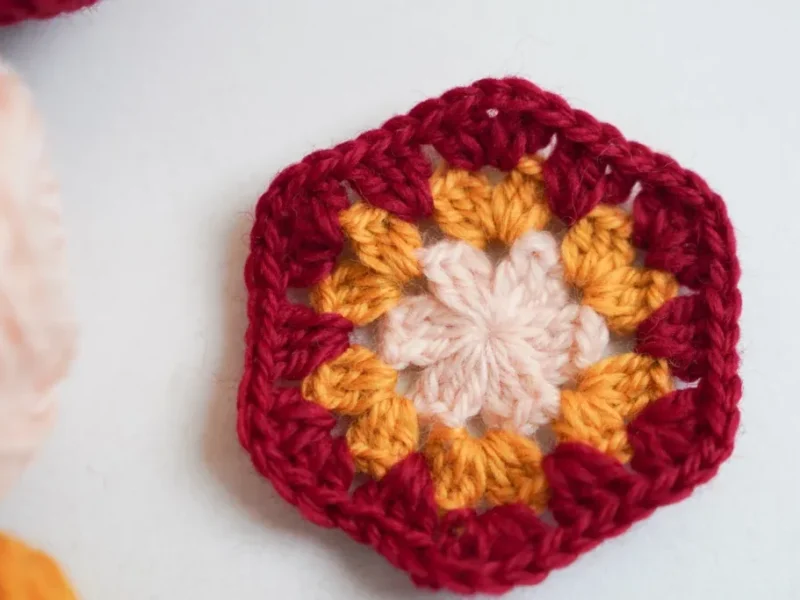
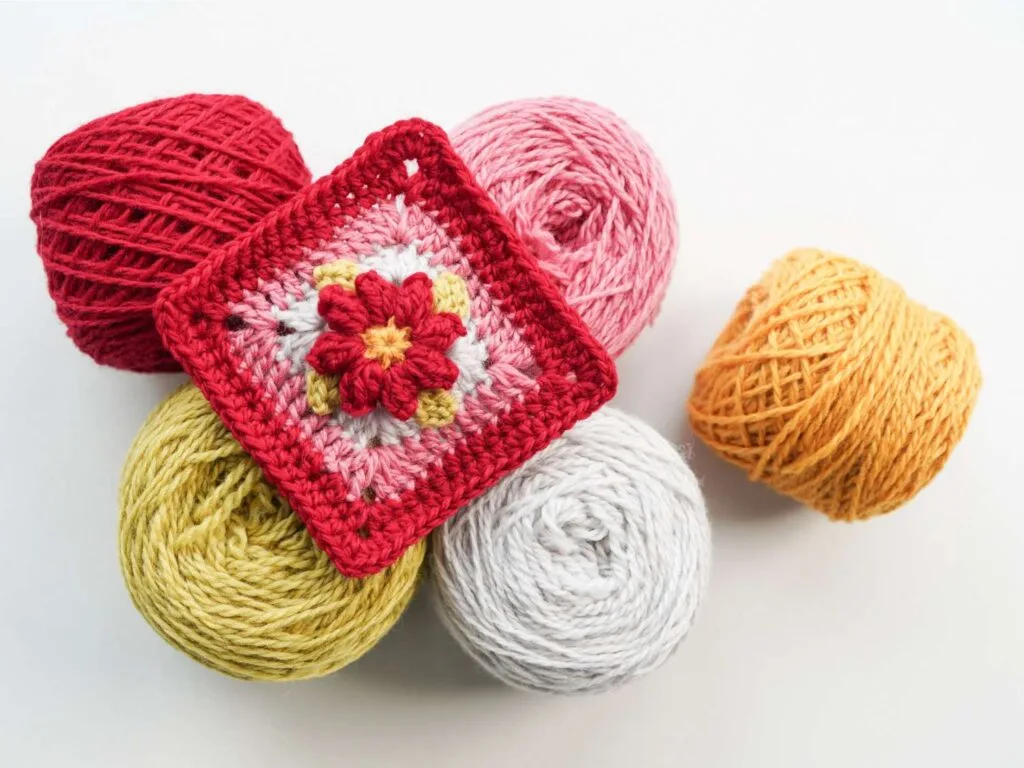
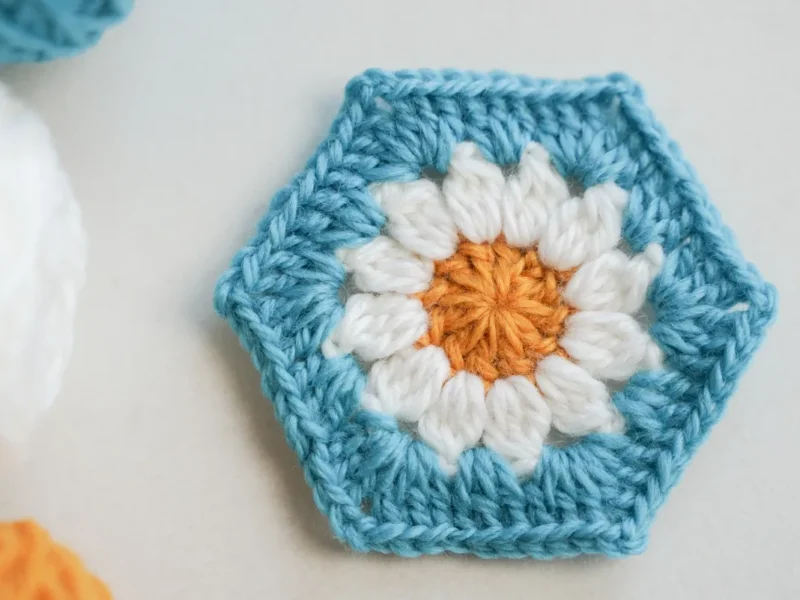
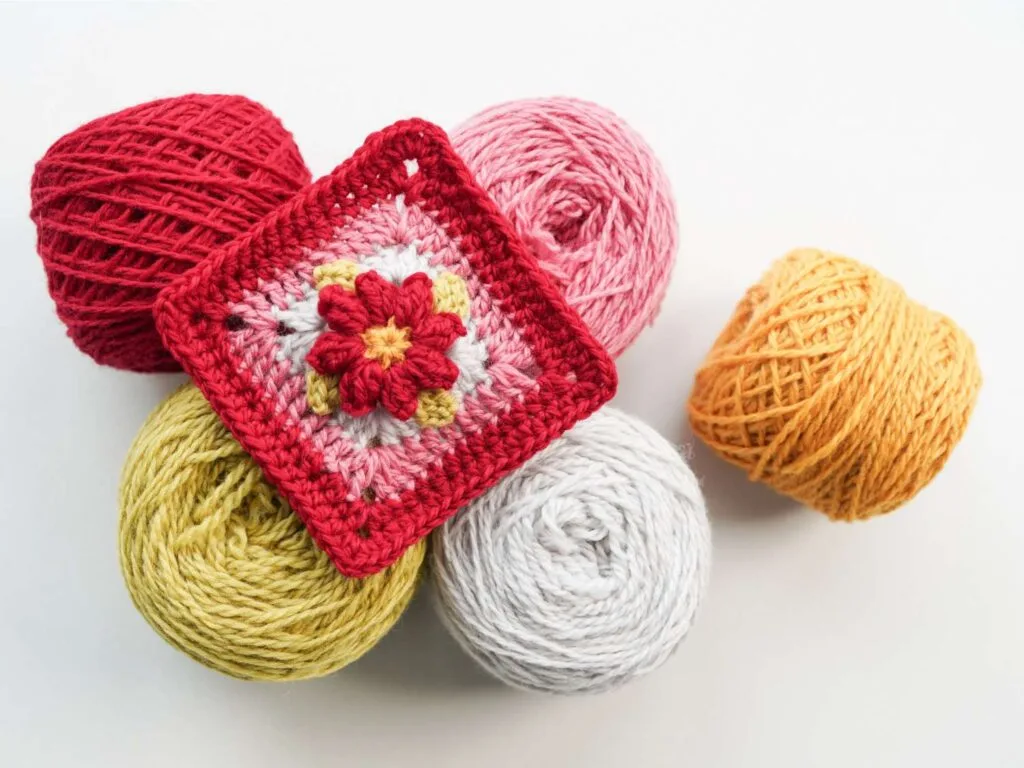
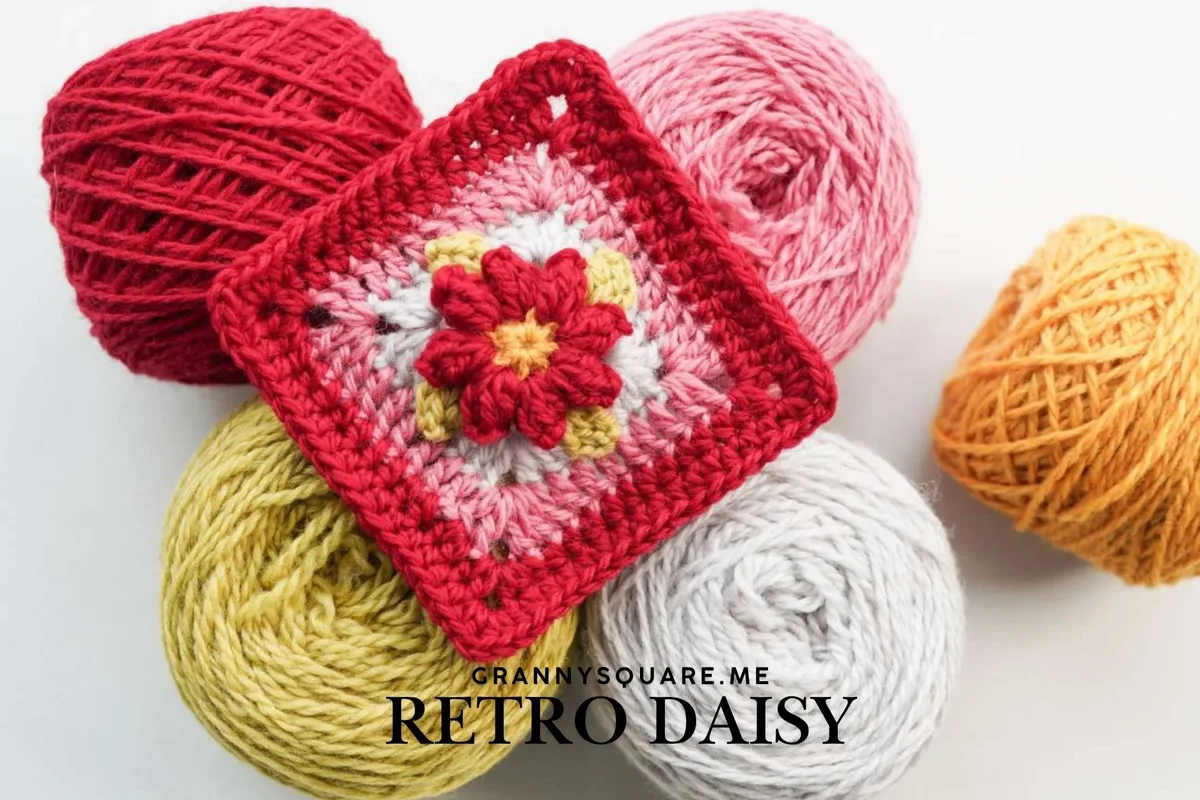
The Retro Daisy Granny Square turns a handful of yarn scraps into a plump, three-dimensional flower framed by classic granny corners. Eight popcorn-stitch petals bloom around a snug half double crochet center, giving the motif that unmistakable vintage-blanket charm straight out of a seventies sitting room. It is perfect for crocheters who are a little bored of flat squares and want texture they can actually feel — and because each motif uses five colors in tiny amounts, it is a dream project for stash-busting
You will begin with a magic loop, work a round of half double crochets separated by chain-2 spaces, then build the daisy with 5-dc popcorn petals before squaring everything off with double crochet corners and clever green 4-dc popcorn leaf accents. The trickiest moment is the incomplete double crochet color change, where you stop a white stitch with two loops on the hook and finish it by pulling green yarn through. Confident advanced beginners can absolutely manage it, and each square works up in roughly one to two relaxed hours
Each finished square measures about 3.94 by 3.94 inches — right around that classic 10 centimeter size that joins beautifully into blankets, cushion covers, tote bags, and cardigan panels. The popcorn petals sit proud of the fabric, so the surface has a soft, bumpy, touchable quality that looks gorgeous in natural light. A stack of these squares tied with ribbon makes a lovely handmade gift for a fellow maker, and a finished daisy blanket is the kind of heirloom that gets gently fought over at family gatherings
Variations
The fastest way to change this square's personality is the palette. For full retro energy, go mustard center, burnt orange petals, avocado leaves, and cream corners — very seventies kitchen curtains. For a soft spring meadow feel, try a buttery yellow center, blush pink petals, sage leaves, and white borders; for a frosty winter set, use silver white petals with icy blue accents on a deep navy final round. A sunflower version is almost automatic: golden yellow popcorn petals around a chocolate brown center, and suddenly it is a late-summer blanket. Scrap-yarn squares where only the background cream stays constant look surprisingly cohesive when joined. For yarn, anything with good stitch definition makes the popcorns shine: Stylecraft Special DK or Paintbox Simply DK for budget-friendly blankets, Scheepjes Catona or Paintbox Cotton Aran if you want crisp, sculptural petals for bags and cushions, and Basic Stitch if you prefer a sturdy worsted. Remember DK with a 4mm hook lands closer to 3.5 inches, while worsted with a 5mm hook pushes toward 4.5 — handy if you need squares to match an existing blanket. To grow the square itself, keep going after the final round: work 3-dc granny clusters in each side space with a 3dc, ch2, 3dc corner in each corner space, and every added round gains you roughly three quarters of an inch. Two extra rounds in a single frame color turns the daisy into a lovely cushion front with no sewing math at all
I have a soft spot for anything that looks like it came out of a 1970s pattern booklet, and this retro daisy delivers that feeling in every single round. My favorite moment is working the 5-dc popcorn petals — there is something deeply satisfying about slipping the hook out of that fifth double crochet, inserting it into both loops of the first, and watching a flat fan of stitches pop into a plump little petal. Eight of them circle the center, and by the end of the petal round you are holding a dimensional daisy that begs to be squished. I also love how the squaring round is engineered: that incomplete double crochet finished with green yarn tucks crisp little leaf popcorns between the white corner clusters with no muddy color blips at all. Because every round fastens off, each new square is a fresh chance to audition a different five-color combination, which makes these dangerously moreish. I made three on my first evening and had a whole blanket planned before bedtime
Common mistakes
- Closing the 5-dc popcorn through the wrong loops, which leaves the petal loose and saggy instead of plump
- After the fifth double crochet, remove your hook completely, insert it under BOTH top loops of the FIRST dc of the group, then catch the live loop of the fifth dc and pull it through. Give the working yarn a gentle tug and the petal will dome up firmly
- Ending up with seven petals instead of eight because a chain-2 space went missing in the first round
- The standing ch2 counts as your first hdc, so after it you need ch2, then [hdc, ch2] seven more times before joining — eight hdc and eight ch-2 spaces total. Count the spaces before you fasten off; frogging round one takes thirty seconds, frogging round three does not
- Joining the round to the top of the ch3 instead of the top of the first popcorn, creating a visible jog in the petal circle
- The pattern joins with a slip stitch to the top of the first popcorn (or the standing stitch), not partway down a chain. Drop a stitch marker into the closing loop of the first popcorn as soon as you make it so the join target is obvious
- Letting popcorns pop toward the back of the work so half your daisy blooms on the wrong side
- Popcorns naturally bulge away from you, so before working the ch3 after each one, nudge it forward with your thumb toward the right side of the square. Check the front after every two or three petals rather than at the end of the round
- A gaping center hole because the magic loop was never fully closed or worked loose
- After joining round one, pull the magic loop tail firmly until the eight hdc close into a tight ring, then weave that tail back and forth through the round-one stitches in two directions. A magic loop that is only pulled tight but not secured will creep open with washing
Intermediate
Materials
- Yarn of your choice- 5 colors
- Crochet hook
- Darning Needle
- Scissors
Main Pattern
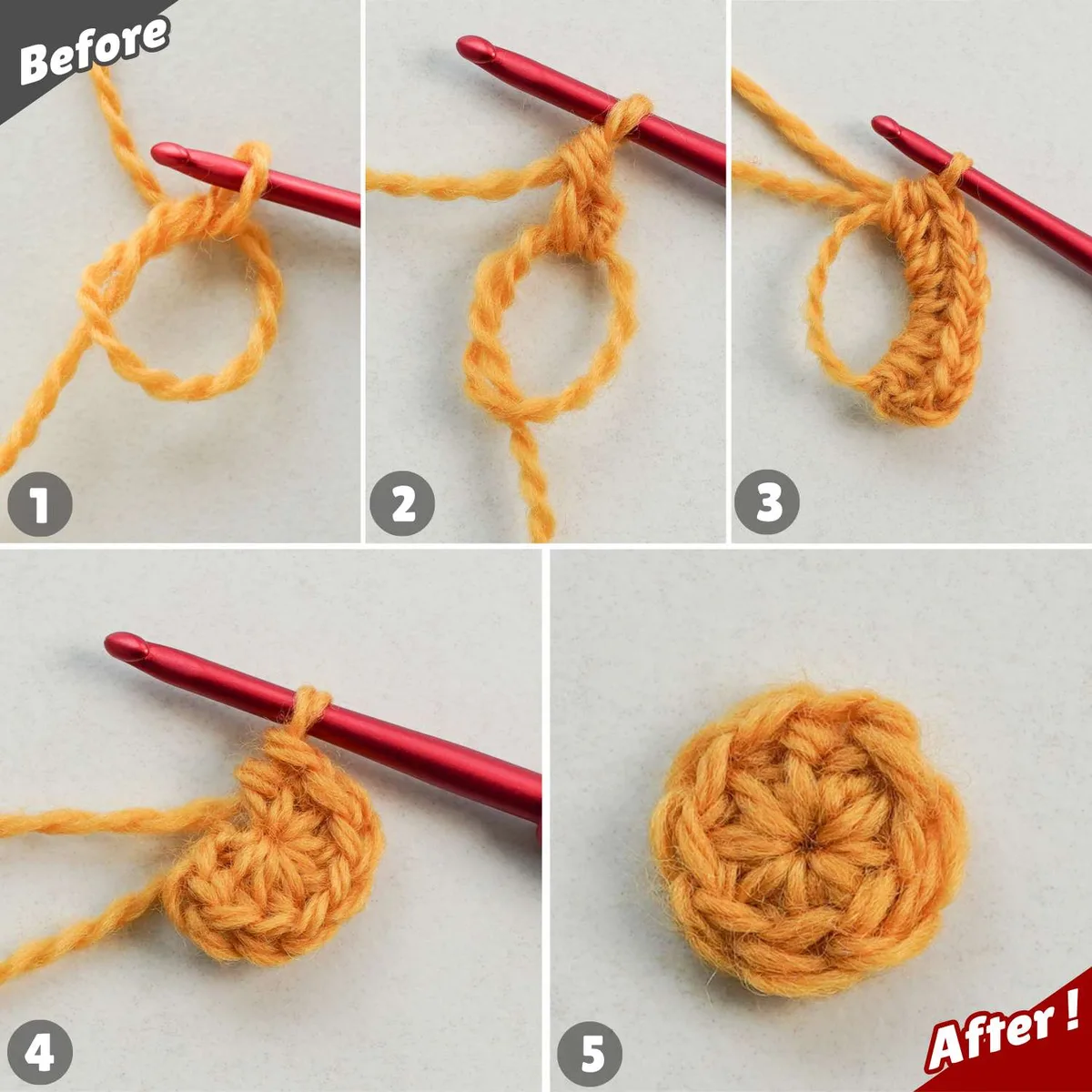
- Round 1Start with a magic loop, ch2(count as hdc), ch2, [hdc, ch2] repeat 7 times, sl st to the top of the first ch2, fasten off (8).(8)
- Round 2New yarn in st, invisible standing st or ch3 (count as dc)+4dc to complete a 5-dc-pc, [5-dc-pc, ch3] repeat 7 times. sl st to the top of first pc, fasten off.
- Round 3New yarn in any ch-sp, ch3 (count as dc)+2dc+ch2+3dc with white yarn, 4-dc-pc in next ch-sp with green yarn, ch with white yarn.
- Round 4[3dc+ch2+3dc in the next ch-sp with white yarn, 4-dc-pc in the next ch-sp with green yarn, ch with white yarn], repeat 3 times, sl st to the top of the first ch 3, fasten off.
- Round 5New yarn in any corner space, ch3(count as dc)+dc+ch2+2dc, 7dc. [2dc+ch2+2dc in the next corner space, 7dc] repeat 3 times, sl st to the top of first ch3.
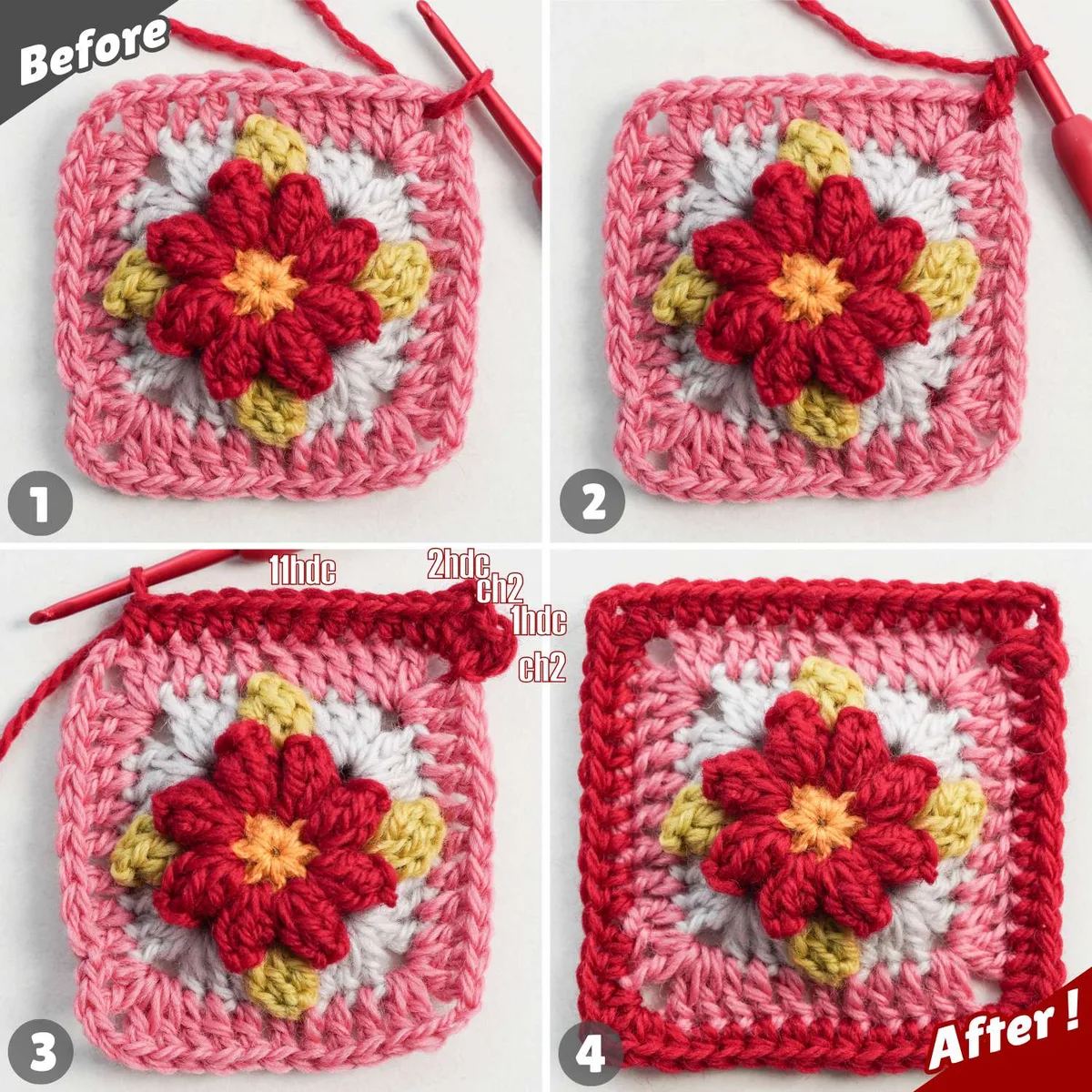
- Round 6New yarn in corner space, ch2(count as hdc)+hdc+ch2+2hdc, 11hdc, [2hdc+ch2+2hdc in next corner space, 11hdc ] repeat 3 times, sl st to the top of the first ch2.
- Round 7New yarn in corner space, ch2(count as hdc)+hdc+ch2+2hdc, 15hdc. [2hdc+ch1+2hdc in next corner space, 15hdc] repeat 3 times, sl st to the top of the first ch2.
Important notes
💡 To hit the 3.94 inch finished size, worsted yarn with a 5mm hook is the sweet spot — but if your popcorns look gappy or floppy, drop down half a millimeter. Dense popcorns are what give this square its retro character
💡 Place a stitch marker in the top of the first popcorn of every popcorn round the moment you complete it. Both the joining slip stitch and next round's placement depend on finding that stitch, and popcorn tops are notoriously hard to read
💡 Every round fastens off, so a five-color square generates ten or more tails. Cut tails at least six inches long and weave each one in before starting the next round — the fabric is still small and easy to handle, and you will never face a fringe of forty ends on a finished blanket
💡 The invisible standing stitch starts each new color without a chain, but if you have never done one, the ch2 or ch3 alternative written into the pattern works fine — just make your chains snug so they do not read as a gap in the petal circle
💡 When you carry the green leaf accents around the squaring round, keep the white strand resting at the back of the popcorn rather than pulling it tight underneath. A tight float will cinch the corner-to-corner edge and stop the square from lying flat
💡 Block your squares before joining: pin each one to 4 inches square on a foam mat, hover a steam iron just above the surface, and let it cool completely. The corners sharpen up beautifully while the popcorn petals keep their height
More photos
FAQ
Do I really have to fasten off after every round?
Yes, and it is worth it — fastening off each round is what keeps the color changes perfectly crisp with no dragged-up loops between the daisy center, petals, and border. Weave each tail in as soon as the round is done and it never becomes a chore
Why does my daisy only have seven petals?
You are probably missing a chain-2 space in round one. The standing ch2 counts as the first hdc, so you need ch2 after it, then hdc and ch2 seven more times, giving eight spaces in total — one home for each popcorn petal
What is the difference between this popcorn stitch and a bobble?
A popcorn is five fully completed double crochets that you join by pulling the last stitch through the first, while a bobble is made of partial stitches closed together in one motion. The popcorn method used here gives a firmer, rounder petal that holds its shape even after washing
Can I use fewer than five colors?
Absolutely. A three-color version with one center color, one petal color, and one background works beautifully, and even a two-color square with contrasting petals looks striking. Just keep the petals in the highest-contrast color so the daisy still reads clearly against the corners
How many squares do I need for a blanket?
roughly 4 inches per square, a 40 by 48 inch lap blanket takes about 120 squares in a 10 by 12 layout, while a baby blanket around 28 by 36 inches needs 63. Joining with a contrasting border color adds close to an inch per seam line, so you can often plan a row or two fewer
Made your own square?
This site belongs to every crocheter. Share your design with the world — we’ll math-check the counts, polish it up, and publish it free for everyone, credited to you.
🧵 Share your pattern →
0 / 0 rounds