Free Pattern
Step-by-Step
Crochet
Granny SquaresSingle Crochet Granny Square – Free Pattern for a Solid, No-Gap Square
Free single crochet granny square pattern. Learn the magic loop start, corner 3sc increases, and how to grow a solid 3.86-inch square in 9 rounds
Level EasyTime 1-2 HoursHook 3.00 mmYarn DK / Sport
About This Pattern
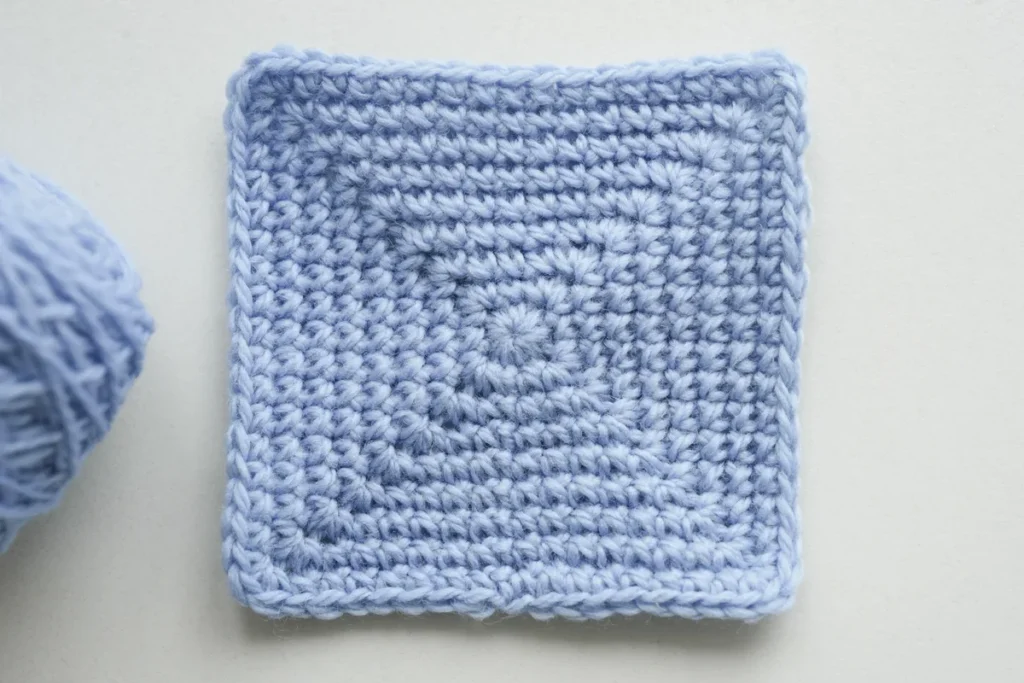
This is the solid granny square — the one without a single lacy gap. Instead of clusters separated by chain spaces, every stitch is a single crochet worked into the stitch below, so the finished fabric is dense, squishy, and completely opaque. That makes it perfect for baby blankets, pot holders, cushion covers, and anything where you don't want little fingers or hot pans slipping through the holes. It's also the ideal square for showing off variegated or hand-dyed yarn, because there's nothing to distract from the color
The whole square is built from exactly two skills: a magic loop to start, and a 3sc increase to turn each corner. Round 1 puts 8 sc into the loop; Round 2 establishes the four corners; and from there every round simply adds one more plain sc before and after each corner group. There are no turning chains to fudge, no clusters to count, no color changes to manage. An advanced beginner will fly through it in under an hour, and even a true beginner can finish it in an evening
Worked in DK or sport weight wool with a 3.00 mm hook, the finished square measures about 3.86 inches by 3.86 inches after nine rounds — a tidy, standard size that plays nicely with almost any join-as-you-go layout. The fabric has real body to it: firm enough to hold its shape, soft enough to drape when you seam a dozen of them together. Stack them in a gradient, and you've got a gift-worthy blanket that looks far more complicated than it actually is
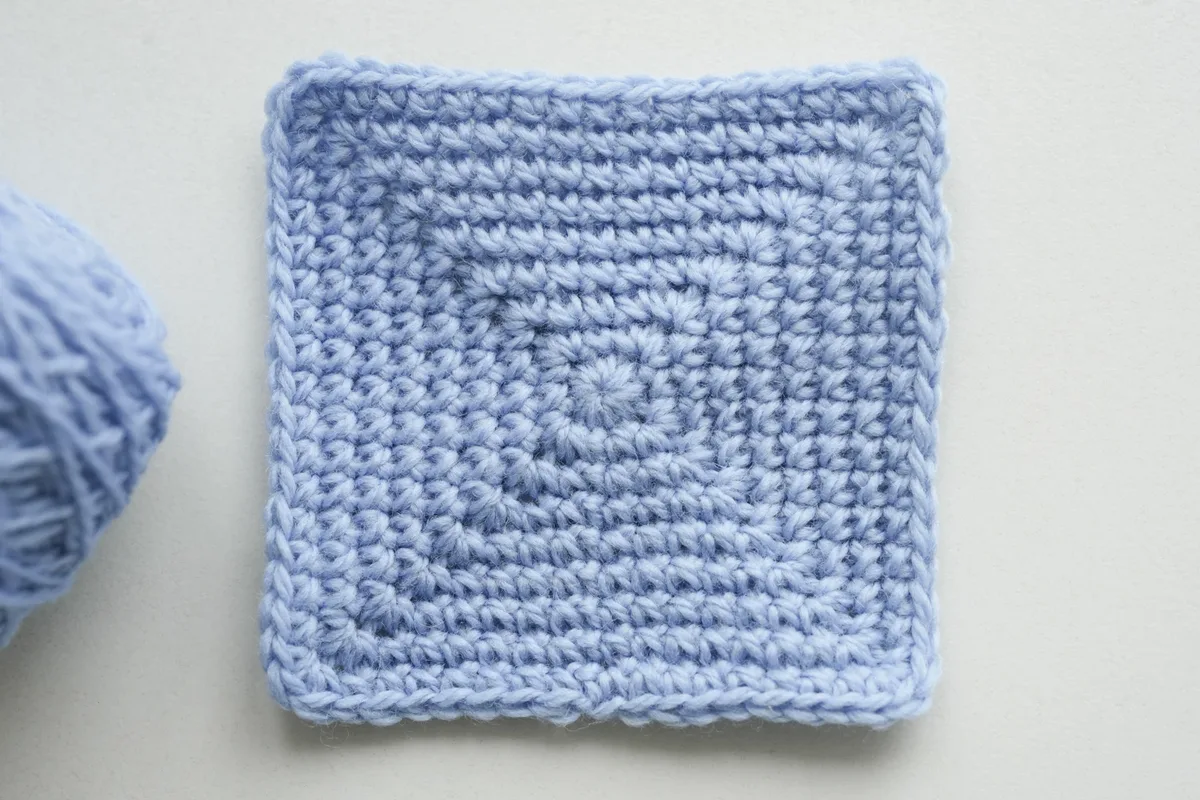
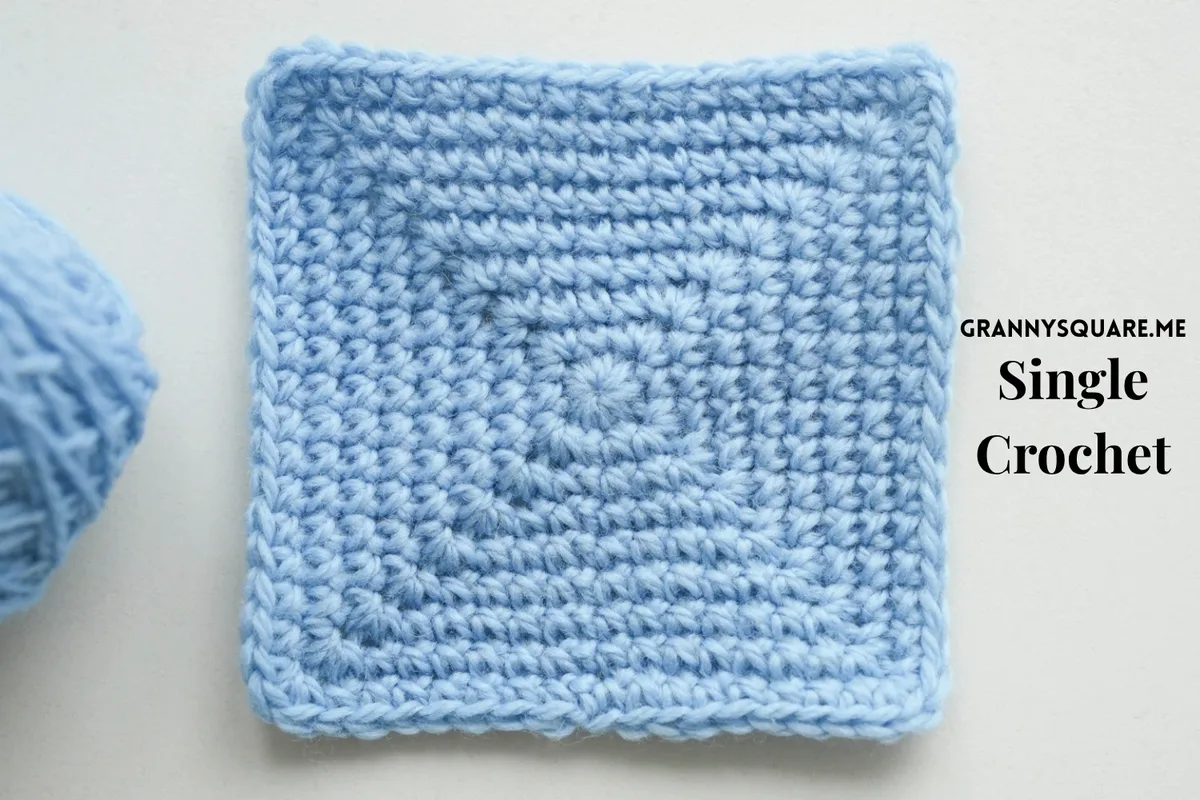
A simple solid granny square in single crochet — beginner-friendly, and ideal for coasters or a sturdy bottom base for crochet bags. The extra structure and durability of the denser fabric is exactly what a bag bottom needs, and the stitch pattern gives the square a unique texture: a lovely diagonal line runs across it, similar to the farmhouse and solid granny square
Variations
The obvious upgrade is color. Because there are no chain spaces, this square handles stripes beautifully — try three rounds of cream, three of dusty rose, and three of terracotta for a warm Moroccan-tile look, or go single-round rainbow with a charcoal final round to frame it. For a scrappy stash-buster, work Rounds 1-6 in random leftovers and every square's Round 7-9 in the same neutral; the shared border makes chaos look intentional. Size is just a matter of when you stop. Fasten off after Round 6 for a roughly 2.5-inch mini square (great for coasters and garland), or keep the established increase going to Round 14 for a chunky 6-inch block — each extra round adds two stitches per side. Want a rectangle instead? Work the increase into only two opposite corners after Round 5 and let the other two sides grow long. Yarn swaps change the character completely. Scheepjes Catona or Paintbox Cotton DK gives you crisp, stitch-definition-forward squares perfect for washcloths and pot holders. Drops Baby Merino or Paintbox Baby DK keeps it cloud-soft for nursery blankets. Go up to worsted with a 4.5 mm hook and the same nine rounds give you a 5-inch square that eats stash twice as fast. For themed versions: pumpkin orange with a cream final round for autumn, forest green and cranberry for winter, or four pastels rotating round by round for spring. A metallic thread held alongside your yarn on Round 9 alone adds a subtle shimmer border without changing the size
I fell for this square the first time I finished Round 4 and realized I hadn't looked at the written pattern once. That's the magic of it — after Round 2 sets up the four corners, the whole thing becomes readable. You just work sc until you reach the little fan of three stitches at the corner, put 3sc into the middle one, and keep going. Each round adds exactly one stitch before and after every corner, so the pattern lives in your hands instead of on the page. I also love how honest the fabric is. There's nowhere to hide a sloppy stitch in solid single crochet, which sounds intimidating but is actually the fastest way I know to tighten up your tension. And the magic loop start? Pull that tail and watch the center vanish into a perfect closed dot — no hole, no chain-4 ring gaping at you from the middle of a baby blanket. Nine rounds later you've got a square with crisp mitered corners and a surface so even it looks knitted. It's the most useful hour of crochet in my rotation
Common mistakes
- The magic loop center pops open after a
- After you slip stitch to close Round 1, pull the yarn tail firmly to cinch the loop shut, then weave that tail through at least four stitches in opposite directions before trimming. Yarns like cotton and superwash wool are slippery and will creep back open if the tail is only woven one way. Some crocheters give the tail a tiny half-hitch knot around a Round 1 stitch before weaving — invisible in solid fabric and permanent
- Working the 3sc corner increase into
- The corner is always the CENTER stitch of the previous round's 3sc group. Look for the little fan — three stitches sprouting from one base — and aim for the middle one. Drop a stitch marker into each of the four center stitches as you make them, then move each marker up as you pass it on the next round. Four markers, four corners, zero guessing
- Miscounting the plain sc between
- The rule is simple: each round adds one sc before and one after every corner. So after Round 3 you have 1 sc between corner and corner-edge, Round 4 has 2, Round 5 has 3, and so on. Count one side at the end of each round — if all four sides match, you're fine. Fix a miscount immediately rather than compensating on the next round, because the error compounds visually
- Treating the Ch1 at the start of each
- The Ch1 is a standing chain only — it exists purely to bring your hook up to height and is never counted or stitched into. The first real stitch is the 1sc worked into the SAME stitch the slip stitch landed in. If your stitch count is one too high every round, this is almost always the culprit
- Slip stitching into the wrong stitch
- Always slip stitch into the FIRST single crochet of the round — not into the Ch1, and not into the slip stitch from the round below. Marking that first sc with a locking marker as you make it removes all doubt. A tidy join keeps the seam invisible in solid fabric, which matters much more here than in an open granny square where chain spaces hide it
- Pulling single crochets too tight, so
- Solid sc has no chain spaces to absorb tension, so a tight hand shows up immediately as curling. Go up half a hook size — 3.5 mm instead of 3.00 mm — and consciously relax the loop on your hook before each pull-through. Blocking will rescue a mildly cupped square, but if it's curling by Round 4, the hook change is the real fix
Easy
Materials
- Yarn of Your Choice, the sample is made with dk sport wool yarn, with a 3.00 mm crochet hook, the finished Single Crochet Granny Square is about 3.86 inches × 3.86 inches
- Crochet Hook, we used a 3.00 mm hook
- Darning Needle
- Scissors
Main Pattern
Before you start Abbreviations are in US terms. The classic granny square is made with double crochet stitches and chains, worked in rounds — here we make a square using single crochet stitches instead. The single crochet granny square creates a tighter, denser fabric compared to the traditional version, which makes it perfect for bag bottoms, where extra structure and durability are needed. It also has a unique texture due to the stitches used: you will find a lovely diagonal line across the square, similar to the farmhouse and solid granny square.
- Round 1Ch1+8sc in a magic loop, slst to the first sc. Pull the tail tightly (8).(8)
- Round 2Ch1 as a standing st, 1sc in the same st, 3sc in the next st; [1sc, 3sc in next st] repeat 3 times, slst to the first sc.
- Round 3Ch1 as a standing st, 1sc in the same st, 1sc, 3sc in the next st, 1sc; [2sc, 3sc in next st, 1sc] repeat 3 times, slst to the first sc.
- Round 4Ch1 as a standing st, 1sc in the same st, 2sc, 3sc in the next st, 2sc; [3sc, 3sc in next st, 2sc] repeat 3 times, slst to the first sc.
- Round 5Ch1 as a standing st, 1sc in the same st, 3sc, 3sc in the next st, 3sc; [4sc, 3sc in next st, 3sc] repeat 3 times, slst to the first sc.
- Round 6-9Work as established, increasing the sc counts before and after each (3sc) by 1 st each round. Fasten off after Round 9.
Important notes
💡 A 3.00 mm hook with DK or sport weight yarn is deliberately tight — it's what gives this square its dense, no-see-through fabric. If your hands run tight naturally, go to 3.25 or 3.5 mm; the square will just finish slightly larger than 3.86 inches, which is fine as long as every square in your project uses the same hook
💡 Use four locking stitch markers, one in each corner's center stitch, and move them up as you complete each round. This is the single biggest time-saver in the whole pattern — it turns corner-hunting into glancing at a marker
💡 If the magic loop still intimidates you, substitute ch 2 and work all 8 sc into the second chain from the hook, then pull the tail. It leaves a marginally larger center than a true magic loop, but in a nine-round square it's nearly invisible
💡 Weave in your starting tail before Round 4, not at the end. Working over it for a few rounds locks it in and saves you from wrestling a short tail through dense fabric later — and dense single crochet is genuinely hard to weave into after the fact
💡 Make one square first and measure it before committing to a full blanket. If yours comes out at 3.5 or 4.2 inches instead of 3.86, adjust your hook now rather than after fifty squares — inconsistent squares are the number one reason granny blankets refuse to lie flat
💡 For blankets, block your squares lightly before joining. Pin each one to 3.86 inches square on a towel or blocking mat, spritz with water, and let dry. Wool blocks beautifully and holds it; acrylic needs steam held above the fabric, never pressed onto it
💡 Gauge and finished size: worked in dk sport wool yarn with a 3.00 mm hook, the finished Single Crochet Granny Square measures about 3.86 inches × 3.86 inches after Round 9. Abbreviations throughout are US terms
More photos
FAQ
Why does my square have holes when it's supposed to be solid?
Solid single crochet shouldn't have any chain spaces, so holes usually mean you accidentally worked a chain between stitches, or your hook is too large for the yarn. Drop down half a hook size and check that you're working every sc directly into the stitch below with no chains in between
How many squares do I need for a blanket?
3.86 inches per square, a baby blanket around 30 x 36 inches needs roughly 8 across by 9 down, so about 72 squares. Add a little for the seams if you're whip-stitching, or make a couple extra to allow for tension variation between crafting sessions
Can I keep going past Round 9 to make a bigger square?
Absolutely — the increase rule never changes, so just keep adding one sc before and after each 3sc corner every round. Round 14 lands you around 6 inches, and Round 20 gives you roughly 8.5 inches in the same DK weight
What's the best way to join these squares?
Because the edges are solid single crochet, whip stitch through the back loops gives a nearly flat, invisible seam that keeps the dense look consistent. Slip stitch joining works too and creates a slightly raised ridge if you want the grid lines to show
Does the color of yarn change the finished size?
It can, surprisingly. Dark dyes — especially black and deep navy — are often processed differently and can crochet up marginally tighter than pale colors in the same yarn line. If you're mixing light and dark in one blanket, measure a square of each and adjust your hook by a quarter millimeter if they don't match
What makes this different from a classic granny square?
The classic granny square is made with double crochet stitches and chains worked in rounds, which leaves open chain spaces. This one uses single crochet throughout, so it creates a tighter, denser fabric with no gaps — great for bag bottoms where extra structure and durability are needed, and it develops a lovely diagonal line across the square, similar to the farmhouse and solid granny square
Made your own square?
This site belongs to every crocheter. Share your design with the world — we’ll math-check the counts, polish it up, and publish it free for everyone, credited to you.
🧵 Share your pattern →
0 / 0 rounds