Free Pattern
Step-by-Step
Crochet
Granny SquaresTriple Squares Granny Square – Free Crochet Pattern
Crochet this free triple squares granny square pattern in 5 easy rounds with 4 pastel colors — a quick 4.5 inch block perfect for blankets and gifts
Level BeginnerTime 1 HourYarn DK
About This Pattern
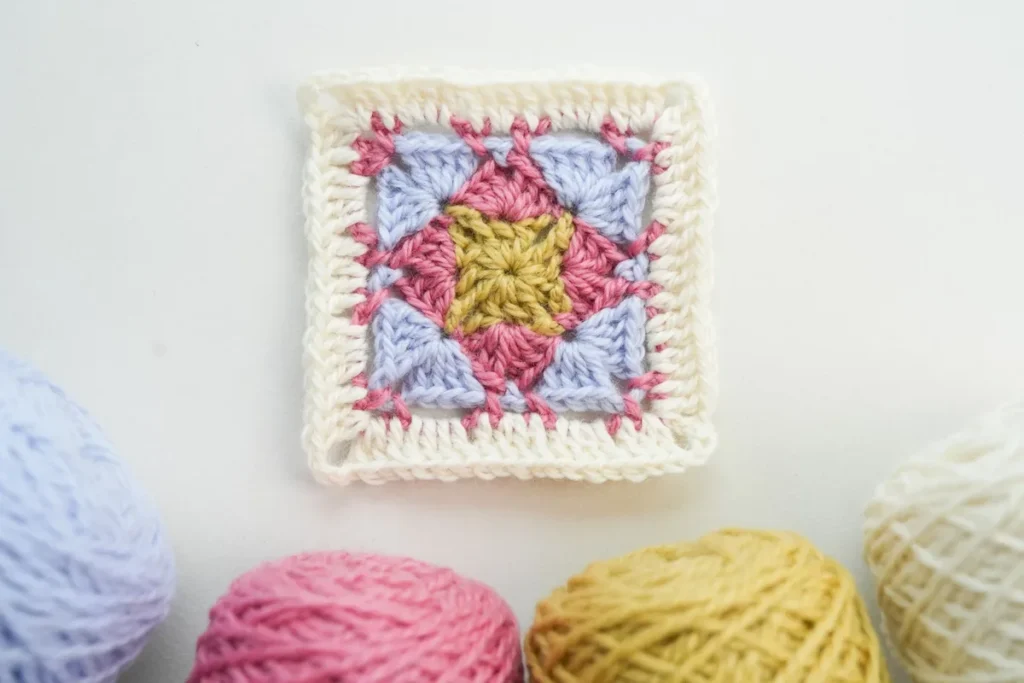
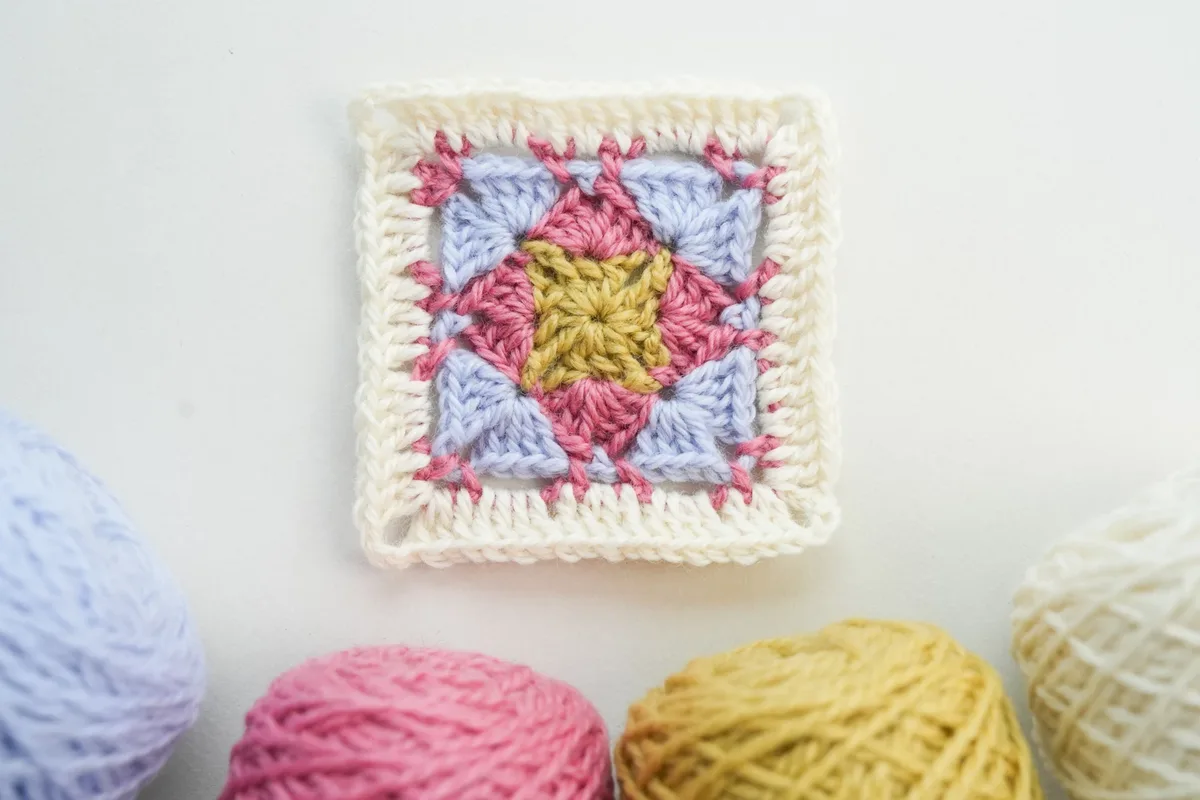
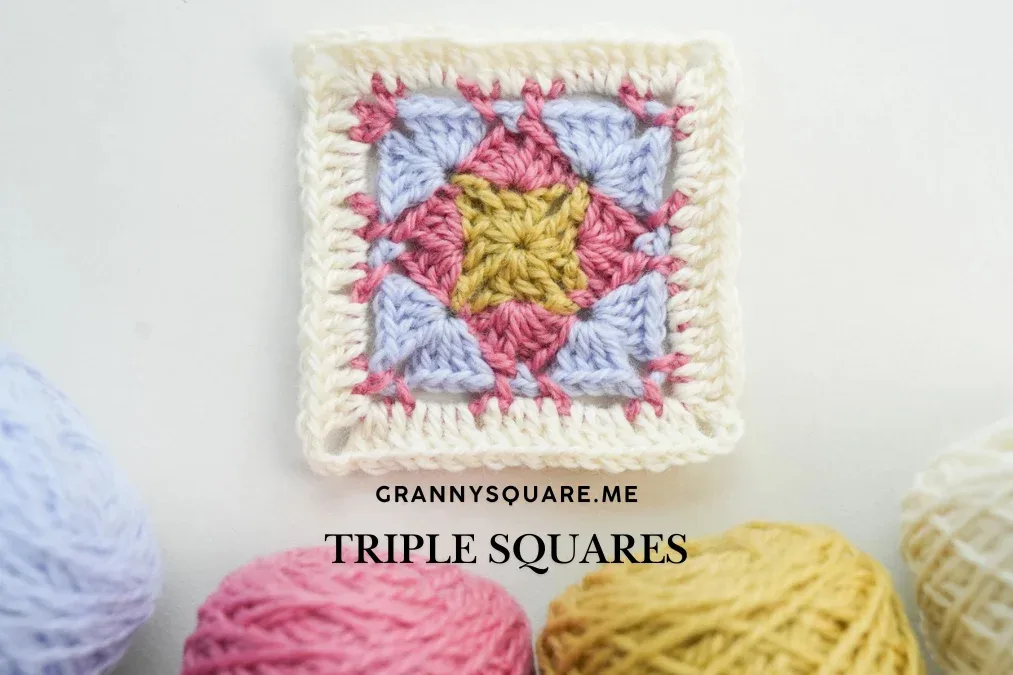
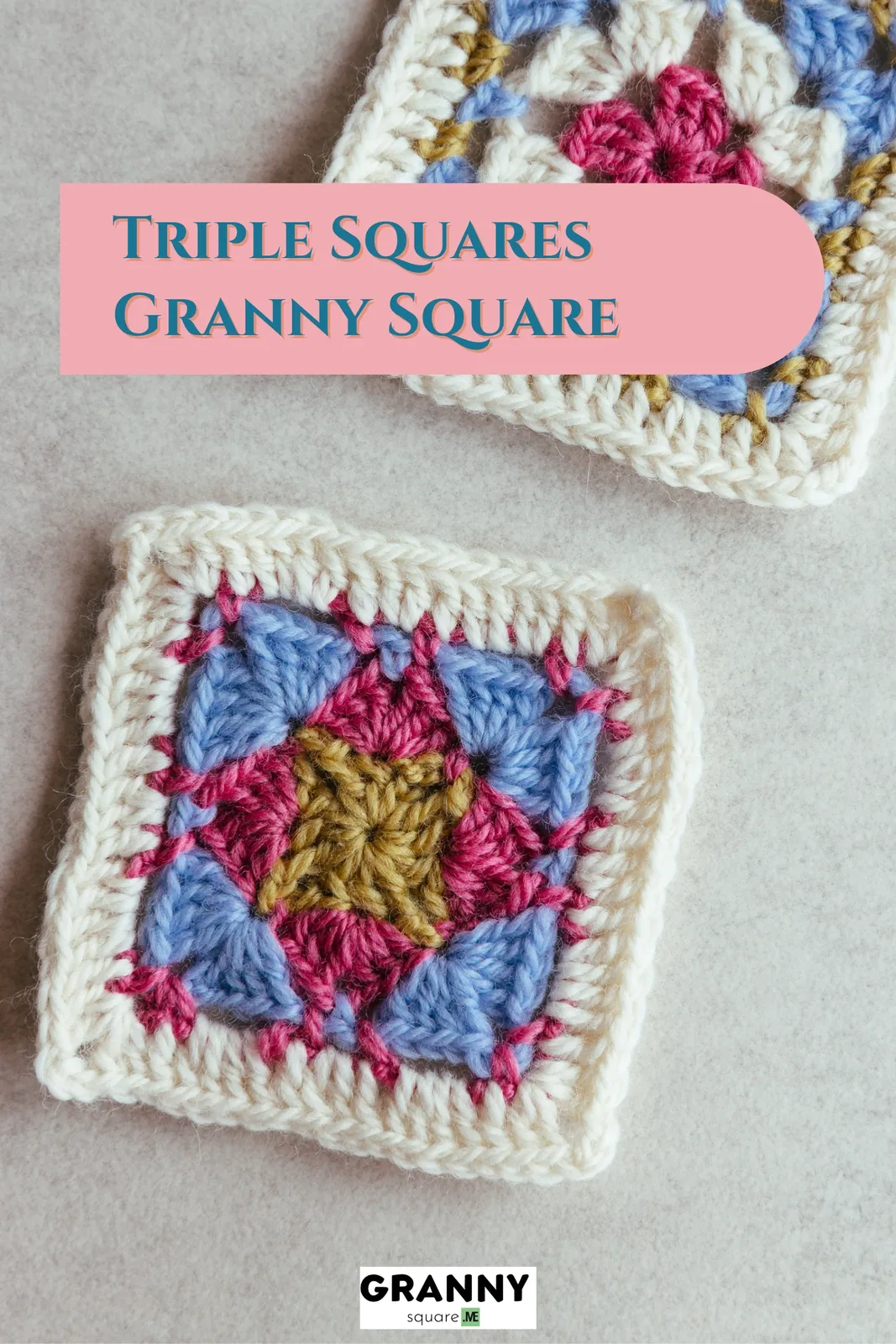
The Triple Squares Granny Square takes the classic granny we all adore and gives it a gorgeous optical twist: by rotating through four colors across five rounds, you create the illusion of three crisp squares nesting inside one another, like a sweet little echo rippling out from the center. It's the kind of motif that looks far more clever than it actually is to make, which is exactly why I love it for newer crocheters who want a square with real visual impact — and for seasoned makers planning their next heirloom blanket
Skill-wise, this one is wonderfully approachable. If you can chain, work a double crochet, and slip stitch to join, you have everything you need — the whole square is built from the traditional 3-double-crochet cluster with chain corner spaces, plus a color change at the start of new rounds. Five rounds work up fast: expect roughly 30 to 45 minutes for your first square, and closer to 20 once the rhythm settles into your hands. It's ideal TV crochet, honestly
Worked in DK sport weight yarn, the finished square measures approximately 4.5 by 4.5 inches — a genuinely useful size that joins beautifully into blankets, cushion covers, tote panels, and table runners. The fabric has that lovely granny drape with just enough structure to hold its shape, and the concentric color bands give even a single square a finished, intentional look. Stitch up a stack in someone's favorite colors and you have a baby blanket or lap throw gift that feels truly personal
Variations
The four-color rotation is where you can really play. The sample's soft pastels are dreamy for baby blankets, but try an autumn story of rust, mustard, cream, and chocolate brown, or a coastal mix of navy, denim, seafoam, and white. For a sophisticated modern throw, work a tonal fade — four shades of the same color from deep to pale — and the nested squares turn into a gorgeous gradient. Holiday versions are irresistible too: evergreen, cranberry, cream, and gold for winter gifting, or blush, red, white, and dusty rose for a February-themed blanket. For sizing, the granny structure makes growth easy: every round adds exactly one more 3-double-crochet cluster per side, so simply keep working rounds in the established pattern. Two extra rounds in a fifth and sixth color takes you to roughly a 6-inch square — perfect for a bolder, faster blanket layout. Going the other way, stop after round 3 for mini squares that make adorable bunting or coaster fronts. Yarn swaps are just as fun. Stylecraft Special DK and Paintbox Simply DK come in enormous color ranges for planning multi-square projects on a budget, while Scheepjes Colour Crafter gives lovely stitch definition for those crisp cluster bands. Substitute a worsted weight like Basic Stitch with a 5 mm hook and your square grows to about 5.5 inches with a cozier, squishier hand — great for quick lap blankets. Or work it in a cotton DK such as Scheepjes Catona for placemats and market-bag panels that hold their shape wash after wash
I'll be honest — I've made more granny squares than I can count, and this triple squares version is the one I keep reaching for when I want that little spark of satisfaction. The magic is in the color rotation: every time you finish a round and join the next shade, another 'square' pops into view around the center, and it genuinely never stops being delightful. Watching those three nested frames appear across just five rounds feels like a tiny reward system built right into the pattern. I also love how forgiving it is. The 3-double-crochet clusters are rhythmic and meditative, the chain-2 corners keep everything crisp and square, and because each round is a fresh color, any tiny wobble from the previous round simply disappears into the new band. And can we talk about stash-busting? Four colors, small amounts of each — this square happily eats up all those half-balls of DK you've been hoarding. It's quick enough for instant gratification, pretty enough to gift, and endlessly repeatable without ever feeling boring
Common mistakes
- Working the first round into a ring
- Whether you begin with a chain ring or your preferred center, keep it relaxed enough to comfortably fit round 1's double crochet clusters. If the stitches are fighting for space, frog back and loosen up — a strained center distorts every round that follows and can even snap under tension later. Work over the starting tail so you can gently snug the center closed afterward
- Forgetting the chain-2 corner spaces
- Every round has exactly four corners, and each one needs its full corner treatment — clusters plus the chain-2 space between them. Pause at the end of each round and physically count four corners before joining. If your 'square' is looking suspiciously circular by round 3, a missed corner space upstream is almost always the culprit
- Joining each new color in the middle of
- a fresh color every round, it's tempting to join anywhere there's a gap. Attach the new yarn exactly where the pattern directs — typically in a corner space — so your cluster counts and corner placement line up. Joining mid-side throws off the sequence and you'll run out of room (or have space left over) when you come back around
- Not counting the starting chain-3 as a
- In granny construction, the chain-3 that starts a round stands in for the first double crochet of that cluster. Work only two more double crochet beside it, not three. If your first cluster of every round looks chunkier than the rest, this is why — and it compounds noticeably across five rounds of color bands
- Ruffling or cupping edges caused
- Those little chain spaces between side clusters set your square's dimensions. Chains worked too loosely add width and create wavy, ruffled edges; too tight and the square cups inward. Aim for chains that match your double crochet tension, and verify: each round should have exactly one more cluster per side than the round before. A light steam block will rescue minor waviness
- Weaving in the ends from four color
- This square produces a healthy handful of tails, and they're the difference between an heirloom and a fringe-y mess. Use your darning needle to weave each tail into the backs of same-color clusters, travel in one direction for an inch, then double back through the plies to lock it. Never trim tails shorter than 6 inches before weaving — give yourself room to work
Beginner
Materials
- Yarn of your choice- 4 colors, the sample is made with DK sports
- Crochet hook
- Darning Needle
- Scissors
Main Pattern
- Round 1Magic ring, ch3(count as dc), 2dc, ch3, [3dc, ch3] rep 3 times, tighten tail, slst to top of ch3, fasten off.Step by step: Start with a magic ring; make ch3 as standing st (count as dc); another 1dc; 1dc, ch3; [3dc, ch3] repeat 3 times; tighten the tail; slst to top of ch3, fasten off. Round 1 finished.
- Round 2Join new color yarn in gap between first and second dc st, ch3(count as dc), (2dc+ch2+3dc) in same gap, sc in next ch-sp, [(3dc+ch2+3dc) in next gap, sc in next ch-sp] rep 3 times, slst to top of ch3, fasten off (28).Step by step: Join new color yarn in gap between first and second dc st; make ch3 as standing st (count as dc); 1dc in same gap; (dc+ch2+3dc) in same gap, sc in next ch-sp; [(3dc+ch2+3dc) in next gap between 2dc, sc in next ch-sp] repeat 3 times, slst to top of ch3, fasten off. Round 2 finished.(28)
- Round 3Join new color yarn in right gap of sc, ch3(count as dc), 3dc in same gap, ch1, sk 3, sc in next c-sp, ch1, sk 3, 4dc in next gap (right of sc), ch3, [4dc in next gap(right of sc), rep from to] rep 3 times, slst to top of ch3, fasten off.Step by step: Join new color yarn in right gap of sc; make ch3 as standing st (count as dc); dc in same gap; 2dc in same gap, ch1, skip 3, sc in next c-sp, ch1, skip 3, 4dc in next gap (right of sc), ch3; [4dc in next gap (right of sc), ch1, skip 3, sc in next c-sp, ch1, skip 3, 4dc in next gap (right of sc), ch3] repeat 3 times, slst to top of ch3, fasten off. Round 3 finished.
- Round 4Join new yarn in corner sp, ch1 as standing st, all sc in ch-sp: [1sc in same corner sp, ch4, 1sc, ch2, 1sc, ch4, 1sc in next corner sp, ch3] rep 4 times, slst to first sc, fasten off.Step by step: Join new yarn in corner space, make all sc in ch-sp; ch1 as standing st; 1sc in same corner space; ch4, 1sc, ch2, 1sc, ch4, 1sc in next corner space, ch3; [1sc in same corner space, ch4, 1sc, ch2, 1sc, ch4, 1sc in next corner space, ch3] repeat 3 times, slst to first sc, fasten off. Round 4 finished.
- Round 5Join new color yarn in ch-3-sp, ch3(count as dc), dc in same ch-3-sp, 14dc(1dc, 4dc in next ch-sp, 1dc, 2dc in next ch-sp, 1dc, 4dc in next ch-sp, 1dc), 2dc in next ch-3-sp, ch3, 2dc in same ch-3-sp, rep fromto 3 times, slst to top of ch3, fasten off and weave in ends.
Step by step: Join new color yarn in ch-3-sp; ch3 as standing st (count as dc); dc in same ch-3-sp; 14dc(1dc, 4dc in next ch-sp, 1dc, 2dc in next ch-sp, 1dc, 4dc in next ch-sp, 1dc), 2dc in next ch-3-sp, ch3; [2dc in same ch-3-sp, 14dc(1dc+4dc in next ch-sp+1dc+2dc in next ch-sp+1dc+4dc in next ch-sp+1dc), 2dc in next ch-3-sp, ch3] repeat 3 times, slst to top of ch3, fasten off and weave in ends. Now we finished a triple squares granny square.
Important notes
💡 Gauge: the completed granny square measures approximately 4.5 inches by 4.5 inches
💡 Color suggestion: the sample uses gentle pastel colors for a sweet, nostalgic feel, but you can absolutely customize with bold brights, elegant neutrals, or any color story that speaks to your creative heart
💡 Hook size matters for hitting that 4.5-inch finished measurement: a 4 mm (US G-6) hook suits most DK sport yarns, but crochet a test square first — if yours comes out small and stiff, go up to 4.5 mm; if it's floppy and oversized, drop to 3.75 mm
💡 Cut manageable working lengths of each of your four colors before you start rather than dragging four full balls around — for a 4.5-inch square, a few yards per round is plenty, and it keeps your project bag blissfully tangle-free
💡 When you fasten off each color, leave a tail of at least 6 inches. With a new color every round, tail management is the real 'skill' in this pattern, and generous tails make the darning needle work painless instead of fiddly
💡 Place a stitch marker in the top of the starting chain-3 of each round — when you come back around to join with a slip stitch, you'll know exactly where to go instead of squinting at a corner full of stitches in the old color
💡 If you're making a batch for a blanket, keep your color rotation order identical in every square and always start new rounds in the same relative corner — your nested-squares effect will line up beautifully when the motifs are joined
💡 Give finished squares a gentle steam block, pinning to exactly 4.5 by 4.5 inches. Blocking sharpens the corners, evens out the cluster bands, and makes seaming dramatically easier when it's time to join squares together
More photos
FAQ
What does 'triple squares' actually mean in this pattern?
It refers to the visual effect, not a special stitch. As you change colors across the five rounds, the contrasting bands create the look of three distinct squares nested inside each other. The construction itself is a traditional granny square throughout
How many of these squares would I need for a baby blanket?
4.5 inches per square, a 7 by 9 layout of 63 squares gives you roughly a 31 by 40 inch blanket before borders. For a lovey-sized 18-inch square, a simple 4 by 4 grid of 16 squares does the job beautifully
Can I use worsted weight yarn instead of DK sport?
Absolutely — pair worsted with a 5 mm (US H-8) hook and follow the pattern exactly as written. Your square will finish closer to 5.5 inches with a thicker, cozier feel, so just recalculate how many squares your project needs
Why isn't my square lying flat?
The usual suspects are tension on the chain spaces or a missed corner. Check that every round has four complete corners and that each side has exactly one more cluster than the previous round. Minor waviness from tension usually disappears with a light steam block
Do I have to use four colors, or can I make it in fewer?
The four-color rotation creates the signature triple-squares look, but the pattern works in any color plan. Try two alternating colors for a bold bullseye effect, or a single color if you just want a quick, classic 5-round granny — the stitch counts stay exactly the same
Made your own square?
This site belongs to every crocheter. Share your design with the world — we’ll math-check the counts, polish it up, and publish it free for everyone, credited to you.
🧵 Share your pattern →
0 / 0 rounds